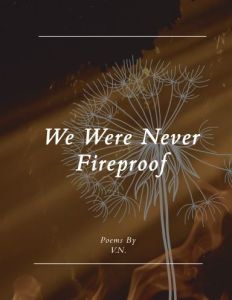
Rarely do I get the opportunity to read poetry that sparks my soul as much as We Were Never Fireproof did. I had the pleasure of discovering V.N.’s poetry on the social media site Threads, and she is a phenomenal poet.
I often shy away from topics such as politics or current events, but V.N. tackles these hard-hitting topics with so much talent. Usually, I take my time and read poetry slowly, but I devoured We Were Never Fireproof in one sitting, reading through it hurriedly because I could hardly get enough of it.
Her poetry is an unflinching look at the world around us, whether it’s the male gaze, how women are exploited, the effects of politics and people in power, and more. V.N. is an extraordinary poet, and more people should read her book.
It exposed me to a world of free verse poetry that I, as both a writer and reader of poetry, needed to be exposed to.
How long have you been writing poetry?
I have been writing since I was a child. I first remember starting to write in 1st grade around age 6-7. I built a little fort underneath my bed and would spend hours there writing and re-writing short stories.
I started trying my hand at poetry later on around age 11. I never shared my poems with anyone, but writing has always been such a great outlet for all of the feelings I can’t name in the moment.
I deal with a lot of anxiety, and poetry has become a way to turn it into something that feels more useful than just allowing the thoughts and feelings to ruminate in my head.
What was the most meaningful poem for you to write in “We Were Never Fireproof” and why?
It is hard to choose, but I think “Metamorphosis” would have to be the most meaningful because struggling with a sense of true identity is something that has been front and center in my life in recent years.
I received a late ADHD diagnosis in my early 20’s and prior to that, I spent my entire childhood and early adulthood feeling as though there was something fundamentally wrong with me that I could not quite figure out. No matter what I did, I always felt like I was constantly getting it wrong and everything felt so much harder than it seemed to be for the other people around me.
I also spent most of that time people-pleasing to an extreme degree and just trying to find a way to fit in and avoid criticism.I developed really rigid coping mechanisms and dealt with extreme anxiety.
Those struggles among other things have led to a disconnect in terms of identity, which I am now trying to piece back together. “Metamorphosis” was my way of putting all of that to paper in a way that felt safe.
For the reader who hasn’t gotten the opportunity to read it, can you talk a bit about your poetry book? What inspired it? What are the general overarching themes? Was it difficult to write about such topics, considering your subject matter?
“We Were Never Fireproof” is a collection of poetry I have written over the past three years. Each poem has a different origin point; some past, some present, some were written as pieces for art therapy projects, but all of them stem from a need to put all of my jumbled emotions down somewhere.
At the start, they were just a random collection of poems, but current events, specifically the election night in Nov. 2024, inspired me to weave them together into something tangible I could hold. The general overarching themes revolve around social commentary, feminism, our current political climate in the US, and survival under systemic corruption.
I know I cannot be the only person holding all of these heavy, anxious, outraged etc. feelings in my body, so I hoped that maybe sharing my book would help another person out there feel seen in the mess of it. It is not difficult to write about the topics, but it is difficult to share. I was afraid to put it out there at first as it is hard to know what is and is not safe, but staying silent does not make anything safer for anyone.
What’s your advice to aspiring poets looking to do more with their writing?
My biggest piece of advice, which is also advice to myself, is share it. Even if you’re scared. Even if you don’t think anyone is going to read it. Even if you think people will hate it. Just share it, put it out there, because you never know who might need to read exactly what you have to offer, and even if it is not for everyone, it’s going to be for someone out there.
As a poetry writer, do you also read poetry? Which poets are your favorites, and does reading poetry affect your writing?
Yes! I love poetry and prose. When I was a kid I loved Shel Silverstien. I even did a spoken word performance of one of his pieces in elementary school.
I also really enjoy Rupi Kaur and Amanda Lovelace.
What I really love though, is reading the poems of strangers on social media. It has become one of my favorite things to see people put their work out there and share it.
It definitely gives me inspiration to write and seeing the ways others use and interpret poetry is always fascinating.
A poem can mean one thing to the writer, and mean something completely different to the reader, and that has always been something I appreciate about poetry.
Each word carries its own weight depending on who is reading it and through what lens.
And I think that art is one of the best ways to cope with difficult things. Right now especially, art can be a form of coping, soothing, truth telling, and resistance and I love that so many people are willing to share their voices through this medium.
We need it.
Where can readers find “We Were Never Fireproof”?
My book is currently available on the Lulu online bookstore – here – or I occasionally share writing on my Threads page: here.
Metamorphosis
Rude
Talking out of turn
Nosey
Loud
Attention-seeking
A little girl calculating words thrown her way
Using them to mold herself
Into the shape of acceptance and belonging
Hoping it will be enough
Mimicking the way others exist in the world
Hoping to find the correct way to be
You read too much
Too quiet
Too shy
Weird
Standoffish
Awkward
A teenage girl calculating words thrown her way, trying to reshape
Remold
With every disapproving glance and comment
Chisels and hammers
A constant metamorphosis
An ever evolving dance
Hoping to be loved, even if for the conformity
But still not enough
Too much
Too little
Too big
Too small
Too loud
Too quiet
Too smart
Too spacey
Too kind
Too cold
Too much too much too much
But never enough
Mold
Change
Evolve
Try to squeeze into the boxes
Take the right shape
Maybe from this angle
Under the perfect lighting
With careful curation
Maybe in this form —
Maybe
Who am I now?
What do I love?
What do I care about?
Is this even me?
Or just a lifetime of collecting harsh words
Assigning weight to their meaning
Calculating my worth by their utterance
Trying to check all the boxes
And contorting to avoid their sting
The mask I wear: the price of admission
A woman, unsure
Identity unknown
Too many boxes, never the right shape
Nothing of her own, to tell her who she is
The world already told her
Time and time again,
Yet still, never enough.
– V.N.
Isabelle Palerma
 Isabelle Palerma