Poet Spotlight on: Keighley Perkins

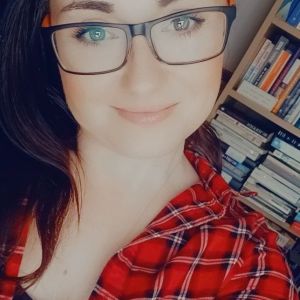
Keighley Perkins is a poet and academic based in Wales whose work explores love, longing and the quiet aftermath of intimacy. Her writing is image-led and emotionally attentive, often dwelling in the small, intimate moments that shape connection: what is said, unsaid and remembered long after.

From a young age, she has been drawn to words: how they work, what they mean and how they taste. This fascination continues to underpin both her creative and academic work where language is not only a tool but a subject in itself.

Her influences include Selima Hill, Richard Brautigan, e.e. Cummings, Anis Mojgani, Rupi Kaur, Dylan Thomas and Jeffrey McDaniel.

Her poetry has appeared Fire, Acumen, Obsessed with Pipework, and Erbacce. Alongside her poetry, she researches political discourse and online harms. More about her academic work can be found here: https://allmylinks.com/keighleyperkins.


What does it feel like when you write a poem? Walk me through that process.

Writing a poem feels like stepping into a heightened state: something between focus and disappearance. There’s a kind of excitement to it, a pull that’s difficult to resist – as if the poem has already begun and I’m just trying to catch up to it.

The world around me seems to shift in two directions at once. Everything else fades: the noise, the movement, the sense of time. At the same time, certain details come into sharp focus. A word, an image, a feeling will suddenly feel illuminated as though it has been waiting to be noticed.

It becomes a kind of slow state but one that feels almost physical. My attention narrows to the page, the pen, the movement of thought. Everything else falls away. There’s something addictive in that: something about being so completely absorbed that nothing else can interrupt it.

At its most intense, it feels like being electrically alive, like something is moving through me faster than I can articulate and my only task is to stay with it for as long as it lasts.

Do you have a word or an emotion you return to in your poetry? What do you think that says about you as a poet or as a person?

I find myself returning to longing, particularly unrequited love. There’s something about that space that feels both delicate and expansive: a quiet tension between joy and ache, presence and absence. It holds a kind of exquisite sadness but also a strange beauty I keep wanting to understand.

More broadly, I’m drawn to intimacy in all its forms. I’m interested in the emotional and psychological undercurrents of relationships: how people connect, misconnect and carry one another long after. That doesn’t always mean romantic love; friendships, too, offer their own depth, their own quiet complexities.

I also notice a pull towards the Gothic in the work. Certain images recur: the moon, ghosts, things that linger just out of reach. I think this connects back to that same fascination with longing. These figures are, in many ways, untouchable: present but not fully graspable. They allow me to explore what it means to want something that cannot quite be held.

Perhaps that says that, as both poet and person, I’m interested in what resists resolution: the spaces where feeling stretches, unsettles and remains.

Do you have a favorite time of day to write?

As much as I am a morning person, I tend to write at night. It’s the point in the day when everything else can be set down, when I can return to the thoughts that have been quietly building, almost unnoticed, beneath the surface.

There’s a sense, at night, of stepping outside of my other roles. I’m not an academic, not a partner – I’m simply myself. It’s a space where the roughness and rawness of my thoughts can emerge more freely without needing to be shaped too quickly.

I think there’s something inherently reflective about the night. It offers a kind of shelter, a stillness that allows for deeper exploration. The world softens, distractions fall away and what remains feels more honest, more immediate. It becomes a time where I can sit with what is hidden and begin to understand it.

Are your poems autobiographical or do they simply show facets of who you are on the page?

My poems often begin in something real: an emotion, a moment, a memory I’ve lived through. Drawing on personal experience allows me to explore those feelings with a kind of emotional honesty that feels difficult to access otherwise.

That said, what happens on the page isn’t a direct transcription of life. I tend to expand, reshape and, sometimes, exaggerate what I’ve felt, allowing the emotion to become more visible, more concentrated. The truth of the experience remains but it is heightened, given a sharper outline so it can be seen more clearly.


So, while my work isn’t strictly autobiographical, it is always rooted in something real. There is usually a trace of lived experience beneath it: a small, persistent thread of truth running through whatever the poem becomes.

Have you ever had to abandon a poem because it got to be “too much” to write? Without getting too personal, can you describe what happened?

When my first dog, Molly, passed away. It was one of the most painful experiences of my life. Writing became the only way I could begin to process that grief but it wasn’t something I could approach in a sustained or structured way. Instead, it came in fragments: isolated lines, half-thoughts, small pieces that felt all I was capable of carrying at the time.

There was something both relieving and unbearable about it. On the one hand, writing allowed me to give shape to what I was feeling, to place it somewhere outside of myself. On the other, each attempt felt like returning to the same wound, like pressing on something that had no intention of healing quickly.

I think that experience taught me that writing doesn’t always offer resolution. Sometimes, it simply creates a space to sit with what is difficult, even when that difficulty resists being fully expressed.

Are you the same person on the page as in real life – poet vs. human? If not, where are the similarities? What are the major differences?

I tend to think of the poet-me and the human-me as the same person, just held in different light. They’re not separate identities so much as different facets, ways of focusing attention, of deciding what to bring into view.

The poet-me is, perhaps, ore deliberate. More composed. There’s a level of shaping and refining that happens on the page, a kind of performance, in the sense that experience is distilled into something more precise, more contained.

In contrast, the human-me is much messier. She lives through things without always understanding them, without the benefit of distance or clarity. It often feels as though the human version gathers the experiences while the poet returns to them later, trying to make sense of what was felt but not fully understood at the time.

Writing, then, becomes a way of creating a stylised version of the self – not inauthentic, but considered. A space where emotion can be arranged, examined and held a little more steadily than it can be in life.


Underground

You have never known
how it is to want like this,

to have ghosts,
riding the underground of your thoughts,
herding your longing home.

-Keighley Perkins

Isabelle Palerma

Poet Spotlight on: Sarah Daly

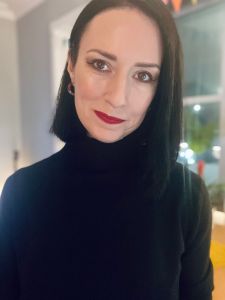
Sarah Daly is an Irish writer living in Edinburgh, Scotland. Sarah has written songs, stories, and poems for as long as she can remember, and is also a screenwriter with the British Horror Studio, which she co-founded with director Lawrie Brewster. Her poetry has featured in an Emmy-award-winning YouTube show, and been performed by legendary actor Gary Oldman. Sarah’s first collection of poetry is due to be released later this year.


Which poets influence you the most?

Honestly, I try to avoid being too influenced by others. Originality is the most important part of expression to me, and so I fear that if I expose myself to too much poetry, I’ll start to emulate other poets, or to unwittingly sound like them.

Undoubtedly, though, the poetry I read or encountered as a child and teenager influenced me to want to write poetry in the first place, and has had an effect on my style. Lewis Carroll was massively formative in terms of how he played with language. It was exciting and inspiring to realize that you could essentially invent your own words and that you really didn’t have to be bound by the rules of the English language.

As an angsty teenager, Emily Dickinson had a big impact. Her work inspired me to write poems that were cathartic and personal and sort of gave me permission to go to dark places with my poems.

What’s your favorite word, and why is it your favorite?

Sesquipedalian, which is a word for people who use a lot of long words. I just love the inherent irony of it, as well as the way it sounds. It sorts of skips around your mouth!

What has writing poetry informed you about being a person? How has it shaped you as a human being?

As a very private person who struggles to express her emotions in ‘real life’, poetry is vital to me. Poems are a place for me to put my feelings. It allows me to wrangle ugly, complicated, lonely thoughts into some kind of structure, maybe even turn them into something beautiful. Quite often, I’ll revisit an old poem of mine and realize it was actually me sending a message to myself, in a way that the fully conscious, logical mind probably never could, sort of like how dreams give us vital information about ourselves. Through my poems, I can see who I am.

And, beyond myself, it helps me to feel more connected to others. When you share something personal, and someone else reaches out to say they feel the same way, or they understand, or it spoke to them, then you feel more connected and less alone. It’s also wonderful to know that my being honest and vulnerable meant that someone else was able to feel less alone in their own experience. This was a somewhat unexpected effect of sharing my poems, but a very beautiful one.

What do you think your childhood self would think of your poetry today?

In a lot of ways, my poetry hasn’t changed that much! It’s improved, I hope, but it has a lot of the same themes, and a similar perspective. My poems are often dark, but always with a strand of hope. They can veer into comedy but usually with something serious to say. I’ve always been particularly sensitive to injustice, fakeness, and hypocrisy, so those are topics I’ve been drawn to speak about for as long as I can remember.

Basically, I think young me would be pleased to see that my core values hadn’t really changed, and honestly, I think she’d just be happy to know that I was still writing at all. It’s certainly not a given that your childhood creativity survives into adulthood.

When did you discover you were a poet? How did that process begin?

I don’t think it was ever a process, just an impulse. I’m pretty sure I was writing stories, songs, and poems as soon as words were available to me–before I could even write them down actually. I remember coming up with songs when I was three years old, singing along to my toy piano. I’m sure it was pretty awful, but it just always came naturally to me to arrange words into pleasing structures and rhythms. 

That said, it’s only in the last couple of years that I’ve felt in any way comfortable with the idea of calling myself a poet. This is the first time in my life I’ve really focussed on poetry in such a purposeful, sustained way. I’ve done a lot of different kinds of writing in my life, and always will, but it feels like “poet” is the best fit to describe the kind of writer I am.

Why do you believe poetry matters?

At its best, poetry can make life’s heaviness a little lighter, it can make us feel seen and understood, can turn difficult, ugly things into beautiful ones, can make us look at the world just a bit differently, and elevate us beyond the base, petty, and mundane parts of the world and ourselves. Poetry is philosophy made pretty. It’s the perfect vessel for truth and beauty, and right now, I think humanity needs both of those things more than ever.


I Speak Poetry

My mouth and mind
were made to weave words
into something more than meaning
something leaning ever
towards beauty

Bleeding truth
out of the spaces
between
sentences.
(The silences at times
are loaded, golden
speaking louder than sound)

Each syllable I spit
is chosen for its peace
or for its power
for its grace or for its grit
I sit with the blank page
and I commit to making the mundane profound

Some poems meant to pierce
and some to soothe
to render safe
or to make dangerous
to shrink the whole life
into a phrase
or blow a moment
up into a universe

Eternity
preserved into a stanza
Forever
whittled to a single word
an ageless expression
of human feeling
healing even as it hurts

Yes, I speak poetry
but I am not unique
every child
was born a poet
born complete
with the sacred, ancient
holy language
every open heart
can speak.

-Sarah Daly

Isabelle Palerma

Poet Spotlight on: Taylor Schwedux

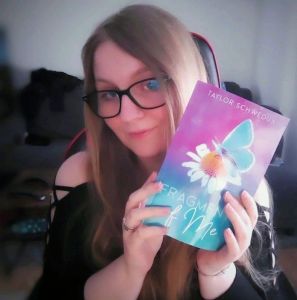
Taylor Schwedux is an Australian self-taught artist and poet residing in Germany with her husband. Her journey  into writing began at a young age, during primary school, where creative writing was one of her favorite activities—even in her free time. Over the years, she transitioned from many creative writing mediums, through songwriting to poetry.


Do you have any rituals when you write?

I do actually! When I sit down to write and want to focus, I refill my water bottle or make a tea on the side to drink, listen to lo-fi kind of music or music that helps to conjure ideas. There are some on YouTube I’ve come across where it sounds like you’re writing in a moving train or at a café. During these times, I also set timers. I may do a 30-45 minute session like this, or sometimes I could go over 2 hours just writing, turning off all the timers because I’ve been really in the zone with it, and my mind is burning with ideas.

Are there any particular poets who inspired you to write poetry?

Upon the first few poems I wrote when I was 13-19 and reworked for the book, I was heavily influenced by William Shakespeare’s sonnets. I had a lot of schoolwork surrounding Shakespeare and his plays. Also, not to mention – Sylvia Plath, Emily Dickinson, Oscar Wilde and Robert Frost.

What emotions are hardest for you to write about with great honesty?

As sad as this may sound, I find writing about happiness the hardest. Happiness to me is not always as universal as sadness or grief can be. When I’m sad, I find writing is the one thing I go to; when I am happy, I tend to live in that happy moment and not write about it was that made me happy.

Since a lot of your poetry seems to be autobiographical, does it ever worry you to share it with others?

Honestly, before publishing I had fears of being misunderstood for how different my life and upbringing is to a lot of people who never had that. It was the opposite for me, I felt a relief, as if weight was being lifted off my shoulders as I set my book out into the world. (Explain why I went ahead and published and why being misunderstood never stopped me).

I read a lot of poetry prior to it being published, especially more modern ones and seeing their works made me feel as though I can do this as well.

What does your first draft of a poem look like?

It definitely leans towards the messy type. I have poems written in my phone notes app, in a writing book, on my PC notes and even at times, scraps of paper If my phone isn’t near me. Thankfully, I keep my scraps of paper in a plastic sheet and go through it as soon as I can , rewriting what I wrote into my book.

When do you usually feel inspiration strike?

Inspiration can strike for me at any time, and sometimes being 3am, in the middle of being in a deep sleep needing to quickly write something on my phone notes. Sometimes when I’m out and about, something may catch my eye or I hear someone say something I will write it down and also a tiny description of what happened, what I heard or saw; to help with documentation of the inspiration.

If you could seal any one line from a poem in a message in a bottle, what would it be?

I think the poem “Dreams”  from Langston Hughes is what I’ll seal into a bottle.
“Hold fast to dreams
For if dreams die
Life is a broken-winged bird
That cannot fly…”


Fire With Fire

To fight fire with fire,
Or to extinguish the flame?
Oh, how I love to play this dangerous game— Me against the dancing blaze.
I feed my sorrow to the embers, Watch them crackle, twist, and grow, As the fire slowly learns what it needs to know.
To fight fire with fire
Or to extinguish the flame?
Perhaps it’s this question,
That’s bound me to this game.

-Taylor Schwedux

Isabelle Palerma

Poet Spotlight on: V.N.

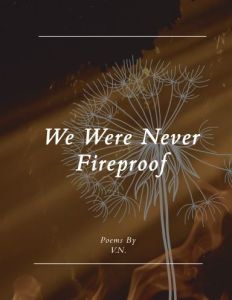
Rarely do I get the opportunity to read poetry that sparks my soul as much as We Were Never Fireproof did. I had the pleasure of discovering V.N.’s poetry on the social media site Threads, and she is a phenomenal poet.

I often shy away from topics such as politics or current events, but V.N. tackles these hard-hitting topics with so much talent. Usually, I take my time and read poetry slowly, but I devoured We Were Never Fireproof in one sitting, reading through it hurriedly because I could hardly get enough of it.

Her poetry is an unflinching look at the world around us, whether it’s the male gaze, how women are exploited, the effects of politics and people in power, and more. V.N. is an extraordinary poet, and more people should read her book.

It exposed me to a world of free verse poetry that I, as both a writer and reader of poetry, needed to be exposed to.


How long have you been writing poetry?

I have been writing since I was a child. I first remember starting to write in 1st grade around age 6-7. I built a little fort underneath my bed and would spend hours there writing and re-writing short stories.

I started trying my hand at poetry later on around age 11. I never shared my poems with anyone, but writing has always been such a great outlet for all of the feelings I can’t name in the moment.

I deal with a lot of anxiety, and poetry has become a way to turn it into something that feels more useful than just allowing the thoughts and feelings to ruminate in my head.

What was the most meaningful poem for you to write in “We Were Never Fireproof” and why?

It is hard to choose, but I think “Metamorphosis” would have to be the most meaningful because struggling with a sense of true identity is something that has been front and center in my life in recent years.

I received a late ADHD diagnosis in my early 20’s and prior to that, I spent my entire childhood and early adulthood feeling as though there was something fundamentally wrong with me that I could not quite figure out. No matter what I did, I always felt like I was constantly getting it wrong and everything felt so much harder than it seemed to be for the other people around me.

I also spent most of that time people-pleasing to an extreme degree and just trying to find a way to fit in and avoid criticism.I developed really rigid coping mechanisms and dealt with extreme anxiety.

Those struggles among other things have led to a disconnect in terms of identity, which I am now trying to piece back together. “Metamorphosis” was my way of putting all of that to paper in a way that felt safe.

For the reader who hasn’t gotten the opportunity to read it, can you talk a bit about your poetry book? What inspired it? What are the general overarching themes? Was it difficult to write about such topics, considering your subject matter?

“We Were Never Fireproof” is a collection of poetry I have written over the past three years. Each poem has a different origin point; some past, some present, some were written as pieces for art therapy projects, but all of them stem from a need to put all of my jumbled emotions down somewhere.

At the start, they were just a random collection of poems, but current events, specifically the election night in Nov. 2024, inspired me to weave them together into something tangible I could hold. The general overarching themes revolve around social commentary, feminism, our current political climate in the US, and survival under systemic corruption.

I know I cannot be the only person holding all of these heavy, anxious, outraged etc. feelings in my body, so I hoped that maybe sharing my book would help another person out there feel seen in the mess of it. It is not difficult to write about the topics, but it is difficult to share. I was afraid to put it out there at first as it is hard to know what is and is not safe, but staying silent does not make anything safer for anyone.

What’s your advice to aspiring poets looking to do more with their writing?

My biggest piece of advice, which is also advice to myself, is share it. Even if you’re scared. Even if you don’t think anyone is going to read it. Even if you think people will hate it. Just share it, put it out there, because you never know who might need to read exactly what you have to offer, and even if it is not for everyone, it’s going to be for someone out there.

As a poetry writer, do you also read poetry? Which poets are your favorites, and does reading poetry affect your writing?

Yes! I love poetry and prose. When I was a kid I loved Shel Silverstien. I even did a spoken word performance of one of his pieces in elementary school.

I also really enjoy Rupi Kaur and Amanda Lovelace.

What I really love though, is reading the poems of strangers on social media. It has become one of my favorite things to see people put their work out there and share it.

It definitely gives me inspiration to write and seeing the ways others use and interpret poetry is always fascinating.

A poem can mean one thing to the writer, and mean something completely different to the reader, and that has always been something I appreciate about poetry.

Each word carries its own weight depending on who is reading it and through what lens.

And I think that art is one of the best ways to cope with difficult things. Right now especially, art can be a form of coping, soothing, truth telling, and resistance and I love that so many people are willing to share their voices through this medium.

We need it.

Where can readers find “We Were Never Fireproof”?

My book is currently available on the Lulu online bookstore – here – or I occasionally share writing on my Threads page: here.


Metamorphosis

Rude
Talking out of turn
Nosey
Loud
Attention-seeking

A little girl calculating words thrown her way
Using them to mold herself
Into the shape of acceptance and belonging
Hoping it will be enough
Mimicking the way others exist in the world
Hoping to find the correct way to be

You read too much
Too quiet
Too shy
Weird
Standoffish
Awkward

A teenage girl calculating words thrown her way, trying to reshape
Remold
With every disapproving glance and comment
Chisels and hammers
A constant metamorphosis
An ever evolving dance
Hoping to be loved, even if for the conformity
But still not enough

Too much
Too little
Too big
Too small
Too loud
Too quiet
Too smart
Too spacey
Too kind
Too cold
Too much too much too much
But never enough

Mold
Change
Evolve
Try to squeeze into the boxes
Take the right shape
Maybe from this angle
Under the perfect lighting
With careful curation
Maybe in this form —
Maybe

Who am I now?
What do I love?
What do I care about?
Is this even me?
Or just a lifetime of collecting harsh words
Assigning weight to their meaning
Calculating my worth by their utterance
Trying to check all the boxes
And contorting to avoid their sting

The mask I wear: the price of admission

A woman, unsure
Identity unknown
Too many boxes, never the right shape
Nothing of her own, to tell her who she is
The world already told her
Time and time again,
Yet still, never enough.

– V.N.

Isabelle Palerma
Poet Spotlight on: Alfred Gremsly

Alfred just recently shared with me a reader review which I feel entitled to share a part of with you all before including his interview. A reader of Alfred’s poetry had said the following:

The candor of this review honestly speaks volumes about Alfred Gremsly’s poetry, and while I am just starting to familiarize myself with his poetry, I can tell he has the same intentions I do with my writing and my day job – to provide a voice to communities normally stigmatized.

Alfred Gremsly is an American born poet who writes about mental health and the struggle that comes with it. A lifelong sufferer of anxiety, depression, and other mental illnesses, Alfred began writing poetry at the young age of twelve as a means of escaping his own mind.


Whose poetry style is most like your own?

I don’t know if anyone’s poetry is like mine.
I don’t read a lot of poetry, and if I do read, it’s going to be something that’s complete opposite of what I write.

Have you received formal training for writing? If so, what’s your background? If not, what got you interested in poetry writing?

I started writing around age 12; I was a very depressed kid. We lived in the country and had nothing to do, and so, I would make homemade books for myself of my thoughts and feelings.

Who are some of your favorite poets?

Some individual poets I like to read are Jan Serene, Ashley Jane, Angie Waters, Margie Watts, and Sarah Kay Collie.

How do you feel when you’re writing a poem? Is it cathartic or do you find it draining? What types of emotions do you experience when writing poetry?


As I, myself, am a lifetime sufferer of depression and anxiety, I have extreme highs and lows. Unfortunately, it takes being in those extreme lows in order for me to get out what I’m needing to say.


I sometimes feel as if writing is a curse of sorts –
so horrible would be the feelings and emotions I’m under while writing.

A lot of my poetry features fractured versions of myself as a narrative voice. What subjects do you write about and how are they influenced by your own experiences?


I write about what I’ve been through in life’s journey – my struggles with mental illness, the feelings of being mentally ill. I have overcome a lot through in life through poetry. I now have a grasp on my depression and anxieties, and I’m now on a mission to help others suffering from mental illnesses.

Where can readers find more of your poetry?

https://instagram.com/poetalfredgremsly

http://www.alfredgremsley.com

https://a.co/d/5B8OkmR


I’ll Be Dead before I’m Better

Am I just pretending
there are voices in my head?
And can anyone else hear
a single thing they’ve said?
Am I really talking to someone
who has been talking back to me?
Or have I just become
a psychotic mystery?
Life’s no fun pretending
when you need a friend
and a therapist is not the answer
when you want the words to end.
Can anyone hear the voices
that are screaming from my head?
I’ll be dead before I’m better
if I’m not already dead

Alfred Gremsly

Isabelle Palerma