Slice through the heart of me
and wonder why I feel so raw.
There’s bleeding somewhere,
and yet I’m still searching for the cut.
I’ll seek out the scars,
but I didn’t know I was the one
clinging to the knife.
Isabelle Palerma
Slice through the heart of me
and wonder why I feel so raw.
There’s bleeding somewhere,
and yet I’m still searching for the cut.
I’ll seek out the scars,
but I didn’t know I was the one
clinging to the knife.
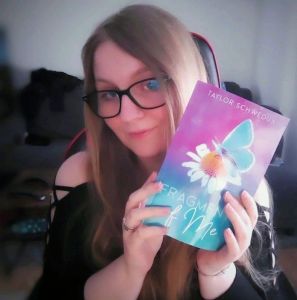
Taylor Schwedux is an Australian self-taught artist and poet residing in Germany with her husband. Her journey into writing began at a young age, during primary school, where creative writing was one of her favorite activities—even in her free time. Over the years, she transitioned from many creative writing mediums, through songwriting to poetry.

Do you have any rituals when you write?
I do actually! When I sit down to write and want to focus, I refill my water bottle or make a tea on the side to drink, listen to lo-fi kind of music or music that helps to conjure ideas. There are some on YouTube I’ve come across where it sounds like you’re writing in a moving train or at a café. During these times, I also set timers. I may do a 30-45 minute session like this, or sometimes I could go over 2 hours just writing, turning off all the timers because I’ve been really in the zone with it, and my mind is burning with ideas.
Are there any particular poets who inspired you to write poetry?
Upon the first few poems I wrote when I was 13-19 and reworked for the book, I was heavily influenced by William Shakespeare’s sonnets. I had a lot of schoolwork surrounding Shakespeare and his plays. Also, not to mention – Sylvia Plath, Emily Dickinson, Oscar Wilde and Robert Frost.
What emotions are hardest for you to write about with great honesty?
As sad as this may sound, I find writing about happiness the hardest. Happiness to me is not always as universal as sadness or grief can be. When I’m sad, I find writing is the one thing I go to; when I am happy, I tend to live in that happy moment and not write about it was that made me happy.
Since a lot of your poetry seems to be autobiographical, does it ever worry you to share it with others?
Honestly, before publishing I had fears of being misunderstood for how different my life and upbringing is to a lot of people who never had that. It was the opposite for me, I felt a relief, as if weight was being lifted off my shoulders as I set my book out into the world. (Explain why I went ahead and published and why being misunderstood never stopped me).
I read a lot of poetry prior to it being published, especially more modern ones and seeing their works made me feel as though I can do this as well.
What does your first draft of a poem look like?
It definitely leans towards the messy type. I have poems written in my phone notes app, in a writing book, on my PC notes and even at times, scraps of paper If my phone isn’t near me. Thankfully, I keep my scraps of paper in a plastic sheet and go through it as soon as I can , rewriting what I wrote into my book.
When do you usually feel inspiration strike?
Inspiration can strike for me at any time, and sometimes being 3am, in the middle of being in a deep sleep needing to quickly write something on my phone notes. Sometimes when I’m out and about, something may catch my eye or I hear someone say something I will write it down and also a tiny description of what happened, what I heard or saw; to help with documentation of the inspiration.
If you could seal any one line from a poem in a message in a bottle, what would it be?
I think the poem “Dreams” from Langston Hughes is what I’ll seal into a bottle.
“Hold fast to dreams
For if dreams die
Life is a broken-winged bird
That cannot fly…”
Fire With Fire
To fight fire with fire,
Or to extinguish the flame?
Oh, how I love to play this dangerous game— Me against the dancing blaze.
I feed my sorrow to the embers, Watch them crackle, twist, and grow, As the fire slowly learns what it needs to know.
To fight fire with fire
Or to extinguish the flame?
Perhaps it’s this question,
That’s bound me to this game.
-Taylor Schwedux

A prompt from a.r. rogers:
“If I gave in to my free will today…”
It’s easy to think someone else
is the master of our circumstances –
a puppeteer
and we’re marionettes, strings tugged on.
But if I were in charge
of my own strings for a change,
perhaps I would cross a few things off
my list – not my to-do list,
but my bucket list.
Instead of going grocery shopping,
I’d go zip lining in the jungle.
Instead of writing poetry in my room,
I’d be performing it on a stage.
Instead of being a coward,
I’d be brave.
Instead of loving,
I’d make love in the rain.
I never wished to be hollow.
I never wished to be empty.
& yet, somewhere along the way,
I lost sight of free will, and I gave my keys
to a different master.
Somewhere along the way, I surrendered
myself and nobody found the heart
to tell me
I could be anything I want.
I just need to rediscover my free will.
This is the beginning of restored sight.
The start of a rediscovery.
I’m giving in to my free will today.
A prompt from Maureen Thorson.
“Write your own poem in which you recount a childhood memory. Try to incorporate a sense of how that experience indicated to you, even then, something about the person you’d grow up to be.”
A date etched into my heart as though
carved into glass.
My eyes were stained with tears, and
I turned to a notebook,
searching for answers about
why God robbed the world of ordinary men
who did their best to love.
I bled ink onto the page as I struggled
for truth
the night no one remembered as
a young lost princess became unmoored.
A prompt from Megan Amber.
“the rules of the game.”
Nobody ever taught me the rules,
yet
it seems like everyone else was given
some kind of handbook
to follow.
I don’t even know if I have the same pieces
or even a game board.
I’m still circling back to square one,
trying to understand where I am
and why I’m here.
The rules of the game were never explicit,
and yet
everyone else knows how to follow them.
I’m lost as usual, searching
for something,
some kind of footing,
some kind of grounding,
but it isn’t a puzzle where you just
slide a piece in and it interlocks.
Nothing makes sense.
Like I said,
I’m lost
as usual,
and I’m stuck
searching for a rulebook,
some kind of handbook
to follow.
 Isabelle Palerma