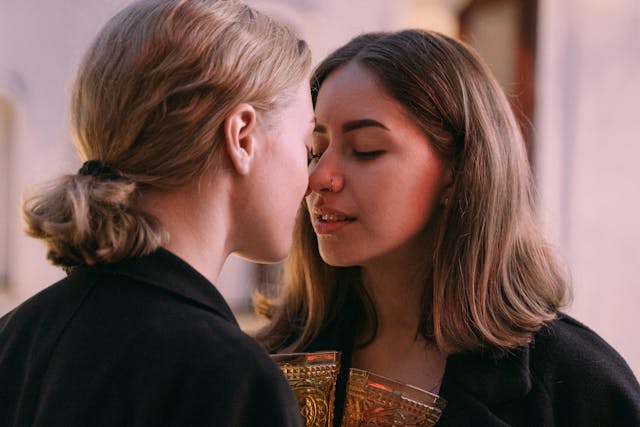
The Dinner: a Short Fiction

“Write a scene set around a table. Communicate each character’s emotions only through how they interact with food.” ( July 4, 2026, Molly Aitken.)


Ethan Porter spears his ribeye and carves into it, barely ripping his gaze from it as his daughter Frances speaks in hushed tones. Frances had returned home from college the night before. He crams a bite of the thick chunk of meat into his mouth, chewing noisily.

Frances swishes a bit of the dry Merlot in her mouth before dragging her fork around on the plate, moving around a few pieces of wilted spinach. She glances up. “Mother,” she says, her voice nearly a whisper. “I have something to tell you.”

Ethan gulps down his gigantic bite and belches. “Whatever you have to say, you can tell both of us.”

Frances’ eyes dart over to her father. Gingerly, she scrapes a tiny bite of potato and chews it. She nods, swallowing the morsel. “Of course.”

Her father continues to shovel more food into his mouth, chuckling to himself. As he loads his fork with meat, he urges Frances with a grunt, “Go on.”

Frances glances at her mother. The girl, lost in thought, drops a small spinach leaf onto her tongue and closes her eyes briefly.

Jessica, Frances’ mother, cuts her ribeye into cubes and when she is certain neither her daughter nor Ethan are paying attention, slips the steak pieces underneath the table to their hungry beagle, Juniper. As soon as she sees Ethan’s beady eyes flash in her direction, she snaps to attention and devours her ribeye with a forced smile.

Then, her wan grin intact, she turns to her daughter. “What is it, doll? You said you had something to tell us.”

Frances sighs and drops another bite of potatoes into her mouth. She chews them silently. She doesn’t speak.

Finally, Jessica breaks the quiet. “It’s not your…” She hesitates. Things like this are hard to bring up. Sensitive. “You’re not…” She pauses again. “Are you… are you in any kind of trouble?” Jessica finally asks, chewing her ribeye so carefully it looks as though she is chewing gum.

Frances’ mouth drops open. A bit of spinach clings to the gap between her front teeth. Had her fourteen-year-old brother Lucas been home, he would have either laughed at her or pointed it out.

Instead, the silence is spectacularly loud.

Finally, she dabs her mouth with a napkin and shakes her head. “No, Mother,” Frances responds firmly, “I’m not in trouble.”

“Then what is it?” Ethan booms, grabbing his bourbon glass and chugging it down as though it were cheap cola — not an expensive liquor.

“Is there any dessert?” Frances asks, glancing away.

“What the hell is going on?” Ethan demands, rising from his seat.

“Daddy, please.” Frances gazes up at him, a bit of ribeye still dangling from her dinner fork.

Jessica, who has been feeding Juniper scraps, glances over at her husband. His face is red and puffy with anger, and his hand is still clenched around the glass. He stabs the ribeye with his fork and bites into it, ripping into it with his teeth and glaring at his family.

“It’s nothing really,” Frances insists, “but I have switched majors.”

Ethan’s eyes bulge out, and his already ruddy face goes more scarlet. His cough is harsh and brash — more of a bark than a cough. When he finally stops coughing, Frances tells them, “I’m no longer studying political science. I’m majoring in Art History.”

Ethan’s head slumps down, the bite of ribeye dislodges and his eyes roll back in his head, watery, unfocused. He rasps out a few mumbled words, then tries again. On his second attempt, they’re more clear but still muddled.

“It doesn’t matter,” he chokes out, slouching forward, “you’ll always be a failure to me.” With one final gasping breath, he falls face-first into what’s left of his mangled steak and mashed potatoes.

Quietly, Jessica stands up and gets a cloth napkin to wipe the meal from her dead husband’s face.

The rest of the dinner is silent.

Isabelle Palerma

This short story is entirely my own content – no A.I. used to create this.

Horror en América and Beyond: an Update

The newest anthology I’m featured in, Horror en América and Beyond, has been released!

Here’s a small blurb about it:

Horror en América and Beyond is a chilling collection by some of the most talented horror and speculative fiction authors, poets, and creative non-fiction writers in the country. It includes terrifying tales by award-winning authors Pedro Iñiguez and Carmen Baca, poetry by Poet Laureates Edward Vidaurree and Juan Perez, and Creative-Nonfiction by the prolific Daniel Olivas.

Each story traverses the boundaries of horror; with topics so fiendishly taboo, yet deliciously mortifying, you’ll be tucking your toes under your blankets at night. With razor-sharp poems unveiling the horrifying nature of American violence, both supernatural and mundane. The non-fiction will have you question the horror of politics in America. This anthology will keep you in a stranglehold until the very last page, and leave you gasping for more!


As usual, you’re more than welcome to purchase it on your own if you’re interested in buying a copy or if you rather, if you’re on my mailing list, I can send you an autographed copy. I would just have to add in mailing expenses. Plus the bonus charge for my autograph. 🙂

Please feel free to let me know if this anthology is something you’d like to add to your collection.

Meanwhile, behind the scenes, I sent Killer of Creatures to three alpha readers and I’m about 34k words into a different novel. I know I should be working on the sequel to Killer of Creatures, but to be honest, I had to leave that on the back burner because I haven’t been feeling very funny lately.

Isabelle Palerma

Pieces of You [Her]: a Short Fiction

Write a story based on a line from a movie.  (June 28, 2025, Out of the Box Prompt.)


“The worst part is I’m starting to forget. I have to constantly make myself remember her. Every day.” (Ricardo Morales from “The Secret in their Eyes”.)

Still frame from the film “The Secret in their Eyes”.

How can you forget the person you love? How can I have looked you in the eye morning after morning, kissed you good night and now, your name is all but a cypher. A code I cannot break. Everything I do, and yet I cannot conjure up the memories of you as I once did.

You are my love. In my notepad – the one where I jot my most important information into – I write your name over and over until it looks like a meaningless scribble, scrawled letters without any context.

I’m too young for this forgetting disease. But they told me it’s not the brain plaque like some folks get. It’s something different, and, of course, the doctors have explained it to me in a thousand different ways. Each time, I think I understand and I write it down, but when I try to read it later, none of it makes sense.

I curl my hand into a fist and slam it onto my desk. It’s frustrating. I feel like a child, or worse, a lab rat.

Telling myself I’ll remember makes no difference. I always end up forgetting. Your name is just empty syllables. Even when I say it, it is ash in my mouth.

I want to curse, but all the words are the same. I curl my hand into a fist and slam it onto my desk. When I look into a mirror, I scarcely recognize the woman I have become. When I pass you in the hall, you are a stranger. Weeping, I beg you to remind me who you are, who we were.

So, you do.

You don’t just say our names, but you tell the history of us. The way you kiss me like the very act of kissing would braid our souls together. You tell me how though you always loved me, you never married me.

At this, I feel my brows furrow.

You explain, “I never wanted to steal your wild. You were a flower I did not want to pluck from the earth.”

I feel myself smile. I feel myself soften.

I wish I could let go because even in forgetting, I still find pieces of you I remember.

Often, you take me into your arms and dance with me, whisper about the scent of the seasons. Spring – honeysuckle. Summer – fresh vanilla. Fall – cinnamon and bon fires. Winter – impending snow storms. You say my scent is your favorite.

That I smell of autumn. I am a woman of cinnamon sticks and bon fires.

But I do not know why. I never wear perfume.

Yet you breathe me in as though I will save you. I begin to forget you.

One day, I struggle for breath. It’s hard to remember. These basic tasks. This remembering.

I gasp. The breath is fleeting. The memories are going, too. I want to say goodbye, good night, but I can’t even remember the breathing.


Eleven years is a long time. You’ll forgive me, won’t you, my love?

We watched the sun rise like a film strip from a movie, drinking Darjeeling tea, every morning. Every moment felt like magic. Her hair, like cinnamon and bon fires. Her skin left me breathless. Enchanted.

We whispered our secrets into the bottom of the kettle and into the shape of each other’s ears, like forming mists and watching them drift away. One morning, after telling my sins, I knotted her a dandelion ring, the only promise I ever knotted her. I asked forever.

Her eyes glittered with tears as she accepted.

It wasn’t marriage, but it was love. I thought when I said forever, I’d wake up with wrinkles etched in our faces. Eleven years is a long time.

She’s been gone, and graves are unyielding, unforgiving. The worst part is I’m starting to forget. I have to constantly make myself remember her.

Every day.

Yet she was the one with the forgetting disease.

My mind is slowing, wading through the molasses-pain of grief, yet the anguish is thick and blurs the details. I wish I could remember, but maybe forgetting is safer. Numbness is safe. There’s a reason surgeons anaesthetize.

But I pull out our photo books. I find the videos I made and listen to her voice. Her lilting accent like a song. Her eyes haunt me, begging me love, love, love, even in memories I scarcely remember.

Forgetting feels safer.

Was she always crying out for help? Was she always begging me for answers?

I wish I could let go because even in forgetting, I still find pieces of her I remember.

Isabelle Palerma

This short story is entirely my own content – no A.I. used to create this.

An Excerpt from a Second Work-in-Progress

Another scene from a different work-in-progress. I’d love to know your opinions!


From miles away, incandescent light glowed from the City of Glass. Beautiful, glittering light sparkled in the inky blue-black twilight. A horse detached itself from a carousel and galloped into the dark, leaving a scintillating gilded trail shimmering behind him. The horse was as black as midnight with golden constellations on his back, desperate to leave his post.

No one was around to see except the young girl who hid behind a twisty and gnarled tree. She did not speak but watched as the bars that had speared the horse separated. The horse had wriggled through and the girl continued to stare at the gold glittering in his wake. She thought she should warn someone in the city, but even here, even now, she had no voice.

It felt like the horse was seeking freedom, and the girl understood the need for freedom, too. But her voice was empty. She had no words.

Under the hollow of the moon, she opened her mouth and screamed. The scream was the only voice she had. And the scream separated the City of Glass and the carousel horse from where she lay, thrashing in a bed.

The shrieking awoke her younger sister who was only a few feet away. She ran to her, bridging the distance. “Evelyn,” the silent girl’s sister cried out, shaking her. She continued to throttle her sister to wake the girl, to stop the screaming.

Tears flowed down both sisters’ cheeks but for vastly different reasons. When Evelyn awoke, her hazel eyes were unfocused. The horse, the horse, she thought, but the words would never come out.

Ella knew better than to expect Evelyn to speak. Everyone did. Yet Ella stared, expectant, hopeful.

But then, as she watched, Evelyn’s demeanor changed. She began to gasp, to clutch at the thin air, clenching and unclenching her fingers. Evelyn’s face paled, the color of paper in the dim moonlight. She lunged forward, grasping at nothing.

Ella gnawed on her lip, helpless. Frightened.

Then, as though all the life-wind had been sucked out of her, Evelyn collapsed backwards on the thin mattress, shuddering. Her frail chest rose and fell. Ella couldn’t help but think how fragile her sister looked. How weak her bones.

At Wyndhurst Academy, the other children often kept to themselves, and that autumn night as the wind whipped against the shutters and the rain pelted the roof, as the girl tossed and turned, they slept. Or at least pretended to.

Ella, Evelyn’s sister, crouched beside her sister’s bed and stroked her hair, coaxing her back to sleep with a quiet lullaby. As Evelyn started to lightly breathe again, Ella pried her sister’s hand open. The fist she had formed held something. Not empty as Ella suspected.

The fingers parted contained a ceramic horse as black as midnight with golden constellations on his back. Its painting was slightly faded, yet Ella was transfixed.

Where had the carousel horse come from, she wondered, and why was Evelyn clutching it like it was a dead man’s treasure?

Isabelle Palerma

This excerpt is entirely my own content – no A.I. used to create this.

Rain Falls Fast: a Short Fiction

For National Short Story Month (like last year), I’m experimenting with writing more short stories.

The prompt from Dylan Drakes’ randomizer is an affectionate yet reckless street performer having to prove her innocence in a dark fantasy/sci-fi mind transfer short story.

Features: dark, potentially triggering imagery.


The way the rain came down wasn’t good for business. Nobody has got time for buskers when it’s pouring down rain. They’re busy shielding themselves from the tears from the sky, and it’s so damn loud. I wish I could just blame the noise on the howl of the wind, the tip-tap of rain on awnings, but it’s all those thoughts.

People’s thoughts get louder – and sadder – on rainy days. Folks wanting to jump from bridges. Take too many pills. It’s enough to break your heart. I’d switch places with them if they’d let me. Bury me six feet under instead.

I never cared about something as petty as my life. But the rain falls fast. Their thoughts loud. And I want to mother them. Protect them from the darkness in their minds.

So, one by one, I guided them out of the rain, out of the city, to a tent. The circus. Where there are clowns and a ringmaster and fire breathers and elephants. Tigers doing tricks. Fortune tellers with crystal balls.

One called me “selfish” as I led the people with the loud thoughts to the circus. “Self-centered” like an accusation. And it stung me like a wasp sting.

“You’re not as sweet as you seem,” a performer hissed.

An eyebrow arched, I had a million questions. I must have allowed him into my mind and vice versa because the words continued there.

Prove this is altruistic, he demanded, prove you’re not doing this just to quiet the streets. To silence your mind.

I wanted a little peace, it was true. Their thoughts interrupted my ability to play my violin. But I genuinely cared. I wanted what was best. Tell me you are innocent. That this is for the people and not for you, Clare.

His wheedling stuck with me. He wasn’t wrong. I was selfish. I always have been. Taking them to the circus wasn’t just charity. It was to quiet my mind. To still the streets. To leave behind the voices.

And yet, one persistent, reckless voice remained, telling me the streets would be so much quieter without a busker, a violinist, named Clare.

I never cared about something as petty as my life. But the rain falls fast. My thoughts loud.

Isabelle Palerma

This short story is entirely my own content – no A.I. used to create this.