I remember tasting the tobacco shored in your lungs, and you had the courage to tell me my auburn hair smelled of a bonfire.
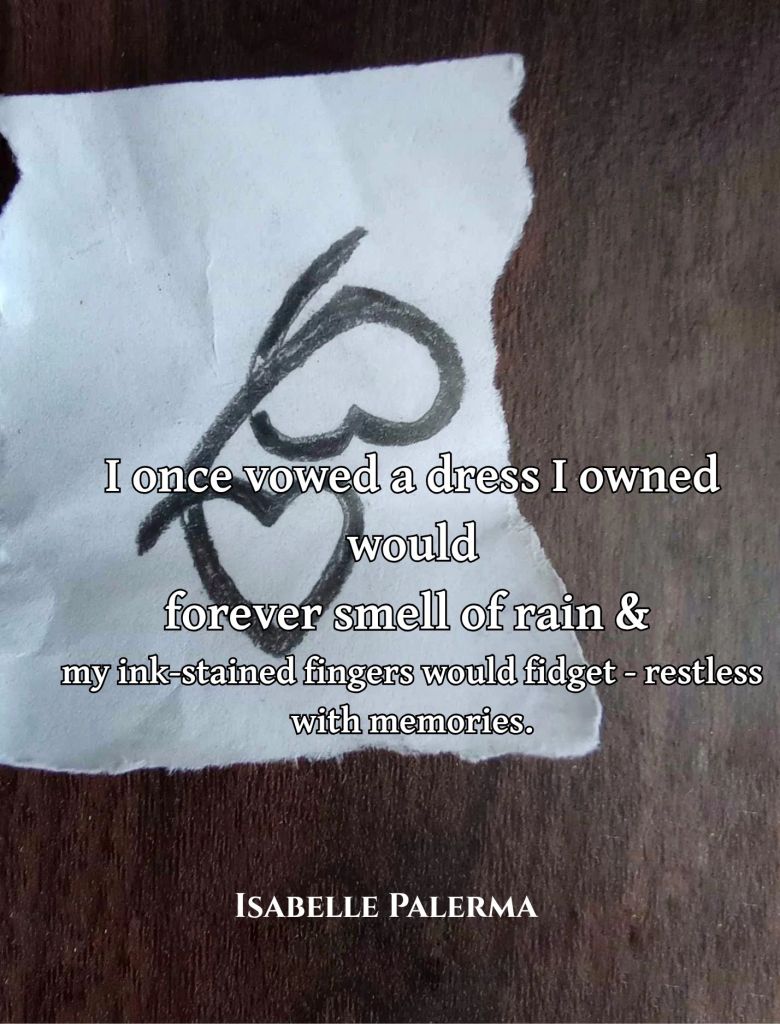
I once vowed a dress I owned would forever smell of rain and my ink-stained fingertips would fidget – restless with memories, but now, when I cradle myself to sleep, my eyes are empty.
I no longer name the silhouettes that landscape my bare walls or dance along my broken skeleton bones.
I remember when my brittle skin was scented like my favorite library, but no one picks up an abandoned tome when the ink that travels the pages is nothing more than a smudge and ashy dots.
I am an empty teacup in a house that is haunted with your name. When I reread the letters you wrote me, shards of glass glitter along voids of thought, threatening to lacerate the emptiness. To puncture the silence where memories once towered like infernos.
Eryn lives in South Germany with their family but is originally from Oxford, UK. They work freelance as a translator and a teacher. When not writing, they’re out on their bike in the forest or dreaming up new ideas to write about. They are obsessed with vinyl, fountain pen ink, dragons and cheese. Preferably not all together. Their current favourite thing is spring blossoms against the white clouds. They are working on two new poetry collections which will be released this year, Masquerade Me and Death by Sugar, and two fiction works, a Dystopian Scifi novella called The Dust Collector and a Gothic Horror called The Black Cat Bookshop.
As a huge fan of your book, which features illuminating poetry on PTSD, I feel like I have to address that. How did you overcome your initial fears and write about a topic that is still so taboo in so many places?
I didn’t want to write something hard, or dark, and I really didn’t want to write a poetry collection that is largely autobiographical. But I found that on occasion when I shared an individual poem, that people really resonated with it. I saw that there’s a lot of poetry about anxiety and depression, but hardly anything for PTSD. And ultimately, sometimes, it is on you to begin it. It was on me to say, this is what PTSD looks like. So it became a collection. It was, and I think will remain, the most difficult collection for me to complete and publish. But I don’t regret it.
Do you sit down with a poetry idea in mind or does it slowly develop as you sit in front of the page or monitor? In other words, what is your process?
I should probably mention that I am an aphant, which means that I have no visual landscape. I cannot conjure a memory and play it back as if it is in glorious technicolour. If someone asks me to imagine a box, I cannot see the colour or texture. I see a nondescript box. So when it comes to poetry, you could say that I am a blind poet.
My visual landscape is layered with music notes and quantum physics. I hear a concept of a poem, a shiver of something, and I have to follow it through to the end. It happens a lot with a phrase, an overhead conversation, perhaps, and then I have to chase the thread to the end. I do not always know where it will turn up.
It’s cliché, but each person’s answer is uniquely their own: what is the best writing advice you have received?
Don’t lose your own poetic voice.
What are three words you would use to describe your poetry?
Lyrical Layered Whimsical
Why do you write poetry?
I have been writing poetry since I was 16, and really, have never stopped. I never intended to make something from it, I never intended to call myself a poet. I studied both poetry and playwriting at University but poetry was the one that survived the grind of assignments, of life getting in the way, and it kept coming back. I write poetry because I need to write it. It is cathartic, somehow.
Is there a common motif in your writing that you find yourself returning to?
There are a few, yes.
In Of Swans and Stars I explored the ideas of my own North Star, that place that calls you home, the direction on the compass that we follow. So swans and stars, are very important to me, and you see amber, being cast in amber, featuring often. I write a lot about Druidry, mythology and folklore. Dragons will always be in my poetry. But at the heart of it all, is always love. Love for who we are, for where we have been, and where we are going.
If you could attend a poetry writing conference taught by any author, lyricist, poet, etc., living or dead, which two to three people would you choose and why?
Larkin. I love him, I love how he writes, his raw energy. Peter Gabriel. His wordsmithery is without equal. WH Auden. I want to hear him read and see how it is reflected in his eyes. I want to see how he writes.
A thousand cranes Paper art flying For peace in the world A thousand cranes Countless painstaking Paper folds For peace in the heart A thousand cranes Flying their dance On white string For peace in the eyes A thousand cranes Quiet time Each repetition A healing caress For peace in the soul A thousand cranes Origami sorcery Peace in the world Starts with ourselves.
Dallas, Texas Poet J.G Gibson is a first time author with his debut book, ‘Feelings’. He is known among the poetry community as clever, poignant and creative in an original way. Most of his work, surrounds the themes of heartbreak, loss, depression, and death but are not limited to those categories.
Upon reading J.G. Gibson’s poetry, on first glance, I was deceived into thinking it was aphoristic writing – somewhat simple and with a clear message. Then, I read it again. And again. Until I realized there is so much more to his poetry than what appears.
What are three words you would you use to describe your poetry?
Clever, lyrical, and entertaining are usually three words that come to mind when I think of my poetry.
From quick wit to rhythm and rhyme, I tend to leave the reader entertained and amazed.
When did you begin writing poetry and what was the impetus?
At age 16. I like to blame music for me becoming a poet. I remember always searching for the lyrics of songs and reading them in my head, without the music playing in the background.
Some of my favorite artists today, are Taylor Swift, Eminem, Kendrick Lamar and The Weeknd.
What are some of your writing habits? How do they affect the content of your poems?
To say I have any writing habits would be a fib. I write sporadically, there’s no schedule or direct process. I do not write everyday.
All I know for sure is I write most frequently when I am emotional – good or bad.
With that being said, most of my themes surround relationships of all kinds – whether it’s death, the downfall of one, weddings, or meeting parents.
My choice of content allows me to highlight different moments and aspects of a relationship.
What is the most difficult part of the poetry-writing process?
For me personally, it is finding subjects I can personify or use as metaphors to elaborate the story that I’m trying to tell. It drives me insane trying to write the perfect-worded poem.
I find in my writing, I include little metaphors or references that only certain readers will understand. Having said that, do you ever include similar references?
Yes, in my upcoming book, “Feelings”, there will be references throughout the whole book that connect poem by poem. I like to think of it as, a loosely episodic structure of a poetry collection.
Why do you think so many readers find poetry inaccessible?
Actually, I do think it’s accessible, but I think it’s been watered down, or modernized. In today’s climate, I always see poems as a caption: it’s a one-line, witty attention grabber. Or it’s substance when posted in other places is cliché. So I do believe poetry is accessible, I just think the people who really love it, don’t really appreciate the statuses which are aka, “the new poetry.”
Carousel
Farewell, carousel that takes me back to you. Round after round thinking, you’ll go around too But you just add change, and yet stay the same, and around I move.
Jimmy Broccoli is a Library Branch Manager by day and a published poet by night with a mission to inspire his readers through imaginative poetic storytelling. His work has been featured in several publications and he released his first full-length book, “Damaged”, on Christmas Day 2021 and compiled the poetry anthology, “Spotlight”, released in March 2022. He enjoys walks on the beach and playing with puppies.
His poetry is raw and tells a story. When you read Broccoli’s poetry, you can feel the emotion of each poem as though you had written it yourself. His poems cut through you like the serrated edge of a knife and don’t hold anything back.
What does poetry mean to you?
I’m a narrative poet, so poetry – for me – is a way to tell stories. Sometimes I write autobiographical poems, sometimes I write fictional accounts – and, often, I write pieces that dwell somewhere in the middle of the two. Much of my writing deals with grief, raw emotions, loss, and death – so poetry, for me, is often a car crash – stories bleeding onto paper or across a computer screen, staining the carpet below. Poetry allows me to express what I would normally keep quiet or secret – it allows me to breathe life into the otherwise unanimated.
When did you begin writing poetry and what has your writing journey been like?
I began writing poetry at age 12 – but didn’t find my “poetic voice” until my early 20s. As an English major at University, I took an upper-level Modern Poetry class and fell in love with confessional poetry – Sylvia Plath, Anne Sexton, Stevie Smith, Edna St. Vincent Millay, and others. My poetic style continues to be heavily influenced by the confessional poets of the mid-1900s.
Whose poetry would you say influences you most? In what ways has it influenced you?
In addition to the modern confessional poets, my poetry is heavily influenced by music – mostly alternative. The lyrics of Nine Inch Nails, Keaton Henson, Morrissey, and Sigur Ros have been more influential upon my writing than the work of other poets. All of these musical artists write highly emotional, powerful, and raw lyrics – exposing the often strange, dangerous, rebellious, extreme, and dark sides of life. It is within this world I usually write. I keep a flashlight handy.
What is your favorite thing about writing poetry?
Poetry, for me, is the escape hatch behind the bedroom closet that opens into a world similar to ours – but more magical and poetic. Writing as Jimmy, I get the opportunity to be someone else for short periods, while still clinging on to my regular identity and life. It’s often thrilling – and a lot of fun.
What is your least favorite thing about writing poetry?
As a side effect of writing raw, emotional verse, the process of writing a poem can take me out of living for several hours or an entire day. When I write very personal poems, usually filled with painful emotions, I become mentally crippled – it’s much like having a temporary mental meltdown – but knowing it will soon be okay. I go through this until my mind tells me, “Hey, it’s time to function again”. Then, I get up and continue with my day.
Tell me about it. It’s an exhausting process writing an emotionally charged poem. What’s your process like?
I never block off or schedule time to write – ideas come to me and – if I like the ideas – I find the nearest pen and paper or computer and begin writing. For me, editing is a constant phase of the writing process – I edit while writing the initial draft and will revisit the piece to edit for the next day or two. I read every line dozens of times – and every time I make a change, I begin reading the poem from the beginning. On average, the initial draft of a poem takes me 2 – 4 hours to write – while the extra editing time can be fairly short (30 minutes) or take a few hours to complete.
As mentioned above, the writing process – for me – can be a painful one – but it is also therapeutic. Writing is a way for me to shed my demons and get out the emotions that have built up over the years. Writing is a release for me.
Who would you have over for lunch of your literary heroes/heroines and what would you serve? What food and which drinks? Why? What would you talk about over the meal?
Well – if musicians who write beautiful lyrics can be considered, I’d invite singer Jón Þór Birgisson (Jonsi), from Sigur Ros, over for lunch. No other writer, from my experience, reaches the epic emotional states Jonsi brings to music and verse.
Both Jonsi and I are vegan – Jonsi is a raw food vegan – so I’d prepare a large vegan platter that included fruits, vegetables, and nuts or bring a Raw Food Pistachio Zucchini Lasagna. A picnic in the park would be nice. I’d bring a sauvignon blanc (white wine) for me and bring whatever he prefers for him. I’m certain we’d talk about him throughout the meal. He’s a fascinating guy and I know I’d learn volumes from him. He is a hero of mine and spending any time with him would be a high honor.
How has poetry changed you?
Poetry has made me more community-minded. I love being a part of the worldwide poetry community and am a member of a good number of poetry groups online. These relationships – often leading to friendships – inspire my writing and are very enjoyable.
His unshaven posture weakens He wilts into my arms as if we’re dancing A delicate dandelion stem exposed to hurricanes A falling toaster into bathwater With bubbles
He is crumpled paper and smeared ink Downturned blue eyes With confidence hung from rope Swinging from unstable rafters Looking down upon a chair with faded and expired paint
I build a fort
Marmalade bed sheets surround his symphony In stillness, I pronounce him king Fluffy life rafts in pillowcases Mix-matched blankets and couch cushions He sits in silence, thinking only in whispers
With evaporated tears, he falls asleep, handsome I hold my breath, then exhale diamonds My emotions spill upon the floor As I listen to him breathing -Jimmy Broccoli
From the Academy of American Poets, a cento is derived from the Latin word for “patchwork”. The cento (or collage poem) is a poetic form composed entirely of lines from poems by other poets.
Love, what is love? I tried to answer, but our language had been lost (and forgotten). So, love’s face may still seem love (to me).
Everything carries me (to you).
Love, what is love? I tried to answer, but our language had been lost (and forgotten).
If little by little, you stop loving me, I shall stop loving you…
If suddenly you forget me do not look for me…
Love, what is love? I tried to answer, but our language had been lost.
If I were a poet, I’d kidnap you. Lyric you in lilacs.
If suddenly you forget me, do not look for me.
Isabelle Palerma
Poems Used:
“Love — What is Love?”, Robert Louis Stevenson.
“In the Dusky Path of a Dream”, Rabindranath Tagore.