Odessa Grimm, in their own words, is a poet who writes from the places people usually avoid – the quiet, heavy corners shaped by memory, trauma, and heartbreak.
Their work is raw and honest; sometimes, according to Odessa, it can be “uncomfortable” because they don’t believe in softening the truth to make it easier to hold.
When did you realize your writing voice had developed into your own?
It wasn’t just a single moment – more like when I noticed I stopped asking for permission to write and be myself. I realized my voice had settled in when I could read something and recognize it as something I was actually proud of.
How do you decide what goes into a poem and what to leave out?
I try to keep what carries weight and brings emotions out. If a line is only there to sound pretty, it usually goes. If it hurts a little, I leave it in.
What would your younger self think of your poems?
I think my younger self would feel seen – maybe a little exposed. Probably surprised the things they tried to hide became the very material I write about. There might be pride there but also a quiet kind of grief, realizing that the reason why I’m writing is because we lost our best friend.
What is a line from a famous poem that haunts you?
A line that stays with me is from Emily Dickinson:
“Tell the truth, but tell it slant.“
It lingers because it understands something essential about poetry that truth can be too sharp to face.
Angling it, shaping it doesn’t weaken it. It makes it survivable, and sometimes, more honest.
Do you believe poetry has the power to shape the world we live in?
I do think it can shape the world we live in but not in loud, immediate ways. It works slower than that. It changes how people see, and once perception shifts, choices follow.
A poem can name something someone didn’t have language for before, and that alone can alter how they move through life.
girls like me stop blooming when we are told your anger is unbecoming your brightness is too much your mouth is a threat so we grey quietly & rot elegantly.
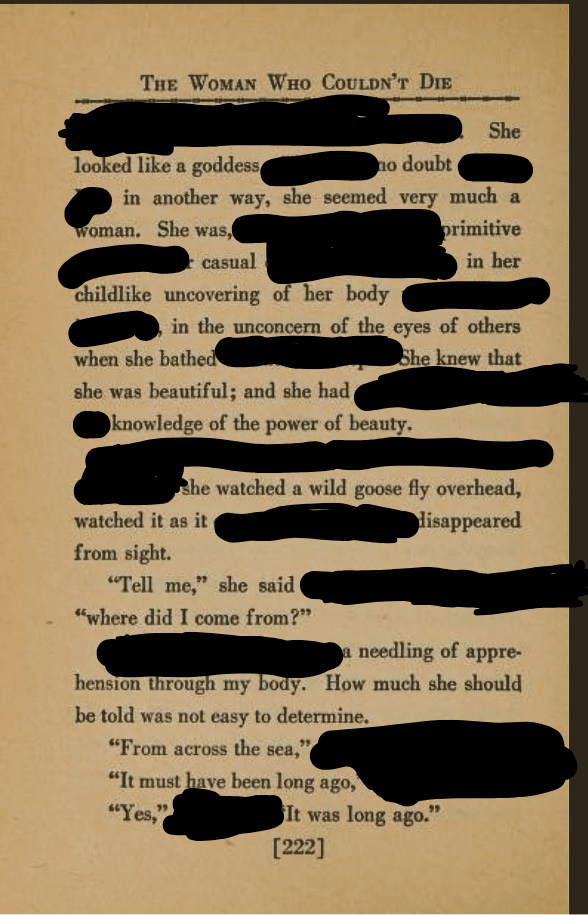
“Write your own blackout poem. Maybe you’ll find something of interest in the Internet Archives.”
According to Claire McNerney, from The Writing Cooperative, “blackout poetry is a form of found poetry where the poet takes a text and removes words from it, creating a new text”.
Here’s mine:
“The Woman who Couldn’t Die”
She looked like a goddess, no doubt, in another way, she seemed very much a woman. She was primitive, casual in her childlike uncovering of her body, in the unconcern of the eyes of others when she bathed. She knew that she was beautiful; and she had knowledge of the power of beauty.
She watched a wild goose fly overhead, watched it as it disappeared from sight. “Tell me,” she said, “where did I come from?”
Needling of apprehension through my body. How much she should be told was not easy to determine. “From across the sea.” “It must have been long ago.” “Yes. It was long ago.”
Keighley Perkins is a poet and academic based in Wales whose work explores love, longing and the quiet aftermath of intimacy. Her writing is image-led and emotionally attentive, often dwelling in the small, intimate moments that shape connection: what is said, unsaid and remembered long after.
From a young age, she has been drawn to words: how they work, what they mean and how they taste. This fascination continues to underpin both her creative and academic work where language is not only a tool but a subject in itself.
Her influences include Selima Hill, Richard Brautigan, e.e. Cummings, Anis Mojgani, Rupi Kaur, Dylan Thomas and Jeffrey McDaniel.
Her poetry has appeared Fire, Acumen, Obsessed with Pipework, and Erbacce. Alongside her poetry, she researches political discourse and online harms. More about her academic work can be found here: https://allmylinks.com/keighleyperkins.
What does it feel like when you write a poem? Walk me through that process.
Writing a poem feels like stepping into a heightened state: something between focus and disappearance. There’s a kind of excitement to it, a pull that’s difficult to resist – as if the poem has already begun and I’m just trying to catch up to it.
The world around me seems to shift in two directions at once. Everything else fades: the noise, the movement, the sense of time. At the same time, certain details come into sharp focus. A word, an image, a feeling will suddenly feel illuminated as though it has been waiting to be noticed.
It becomes a kind of slow state but one that feels almost physical. My attention narrows to the page, the pen, the movement of thought. Everything else falls away. There’s something addictive in that: something about being so completely absorbed that nothing else can interrupt it.
At its most intense, it feels like being electrically alive, like something is moving through me faster than I can articulate and my only task is to stay with it for as long as it lasts.
Do you have a word or an emotion you return to in your poetry? What do you think that says about you as a poet or as a person?
I find myself returning to longing, particularly unrequited love. There’s something about that space that feels both delicate and expansive: a quiet tension between joy and ache, presence and absence. It holds a kind of exquisite sadness but also a strange beauty I keep wanting to understand.
More broadly, I’m drawn to intimacy in all its forms. I’m interested in the emotional and psychological undercurrents of relationships: how people connect, misconnect and carry one another long after. That doesn’t always mean romantic love; friendships, too, offer their own depth, their own quiet complexities.
I also notice a pull towards the Gothic in the work. Certain images recur: the moon, ghosts, things that linger just out of reach. I think this connects back to that same fascination with longing. These figures are, in many ways, untouchable: present but not fully graspable. They allow me to explore what it means to want something that cannot quite be held.
Perhaps that says that, as both poet and person, I’m interested in what resists resolution: the spaces where feeling stretches, unsettles and remains.
Do you have a favorite time of day to write?
As much as I am a morning person, I tend to write at night. It’s the point in the day when everything else can be set down, when I can return to the thoughts that have been quietly building, almost unnoticed, beneath the surface.
There’s a sense, at night, of stepping outside of my other roles. I’m not an academic, not a partner – I’m simply myself. It’s a space where the roughness and rawness of my thoughts can emerge more freely without needing to be shaped too quickly.
I think there’s something inherently reflective about the night. It offers a kind of shelter, a stillness that allows for deeper exploration. The world softens, distractions fall away and what remains feels more honest, more immediate. It becomes a time where I can sit with what is hidden and begin to understand it.
Are your poems autobiographical or do they simply show facets of who you are on the page?
My poems often begin in something real: an emotion, a moment, a memory I’ve lived through. Drawing on personal experience allows me to explore those feelings with a kind of emotional honesty that feels difficult to access otherwise.
That said, what happens on the page isn’t a direct transcription of life. I tend to expand, reshape and, sometimes, exaggerate what I’ve felt, allowing the emotion to become more visible, more concentrated. The truth of the experience remains but it is heightened, given a sharper outline so it can be seen more clearly.
So, while my work isn’t strictly autobiographical, it is always rooted in something real. There is usually a trace of lived experience beneath it: a small, persistent thread of truth running through whatever the poem becomes.
Have you ever had to abandon a poem because it got to be “too much” to write? Without getting too personal, can you describe what happened?
When my first dog, Molly, passed away. It was one of the most painful experiences of my life. Writing became the only way I could begin to process that grief but it wasn’t something I could approach in a sustained or structured way. Instead, it came in fragments: isolated lines, half-thoughts, small pieces that felt all I was capable of carrying at the time.
There was something both relieving and unbearable about it. On the one hand, writing allowed me to give shape to what I was feeling, to place it somewhere outside of myself. On the other, each attempt felt like returning to the same wound, like pressing on something that had no intention of healing quickly.
I think that experience taught me that writing doesn’t always offer resolution. Sometimes, it simply creates a space to sit with what is difficult, even when that difficulty resists being fully expressed.
Are you the same person on the page as in real life – poet vs. human? If not, where are the similarities? What are the major differences?
I tend to think of the poet-me and the human-me as the same person, just held in different light. They’re not separate identities so much as different facets, ways of focusing attention, of deciding what to bring into view.
The poet-me is, perhaps, ore deliberate. More composed. There’s a level of shaping and refining that happens on the page, a kind of performance, in the sense that experience is distilled into something more precise, more contained.
In contrast, the human-me is much messier. She lives through things without always understanding them, without the benefit of distance or clarity. It often feels as though the human version gathers the experiences while the poet returns to them later, trying to make sense of what was felt but not fully understood at the time.
Writing, then, becomes a way of creating a stylised version of the self – not inauthentic, but considered. A space where emotion can be arranged, examined and held a little more steadily than it can be in life.
Underground
You have never known how it is to want like this,
to have ghosts, riding the underground of your thoughts, herding your longing home.
Sarah Daly is an Irish writer living in Edinburgh, Scotland. Sarah has written songs, stories, and poems for as long as she can remember, and is also a screenwriter with the British Horror Studio, which she co-founded with director Lawrie Brewster. Her poetry has featured in an Emmy-award-winning YouTube show, and been performed by legendary actor Gary Oldman. Sarah’s first collection of poetry is due to be released later this year.
Which poets influence you the most?
Honestly, I try to avoid being too influenced by others. Originality is the most important part of expression to me, and so I fear that if I expose myself to too much poetry, I’ll start to emulate other poets, or to unwittingly sound like them.
Undoubtedly, though, the poetry I read or encountered as a child and teenager influenced me to want to write poetry in the first place, and has had an effect on my style. Lewis Carroll was massively formative in terms of how he played with language. It was exciting and inspiring to realize that you could essentially invent your own words and that you really didn’t have to be bound by the rules of the English language.
As an angsty teenager, Emily Dickinson had a big impact. Her work inspired me to write poems that were cathartic and personal and sort of gave me permission to go to dark places with my poems.
What’s your favorite word, and why is it your favorite?
Sesquipedalian, which is a word for people who use a lot of long words. I just love the inherent irony of it, as well as the way it sounds. It sorts of skips around your mouth!
What has writing poetry informed you about being a person? How has it shaped you as a human being?
As a very private person who struggles to express her emotions in ‘real life’, poetry is vital to me. Poems are a place for me to put my feelings. It allows me to wrangle ugly, complicated, lonely thoughts into some kind of structure, maybe even turn them into something beautiful. Quite often, I’ll revisit an old poem of mine and realize it was actually me sending a message to myself, in a way that the fully conscious, logical mind probably never could, sort of like how dreams give us vital information about ourselves. Through my poems, I can see who I am.
And, beyond myself, it helps me to feel more connected to others. When you share something personal, and someone else reaches out to say they feel the same way, or they understand, or it spoke to them, then you feel more connected and less alone. It’s also wonderful to know that my being honest and vulnerable meant that someone else was able to feel less alone in their own experience. This was a somewhat unexpected effect of sharing my poems, but a very beautiful one.
What do you think your childhood self would think of your poetry today?
In a lot of ways, my poetry hasn’t changed that much! It’s improved, I hope, but it has a lot of the same themes, and a similar perspective. My poems are often dark, but always with a strand of hope. They can veer into comedy but usually with something serious to say. I’ve always been particularly sensitive to injustice, fakeness, and hypocrisy, so those are topics I’ve been drawn to speak about for as long as I can remember.
Basically, I think young me would be pleased to see that my core values hadn’t really changed, and honestly, I think she’d just be happy to know that I was still writing at all. It’s certainly not a given that your childhood creativity survives into adulthood.
When did you discover you were a poet? How did that process begin?
I don’t think it was ever a process, just an impulse. I’m pretty sure I was writing stories, songs, and poems as soon as words were available to me–before I could even write them down actually. I remember coming up with songs when I was three years old, singing along to my toy piano. I’m sure it was pretty awful, but it just always came naturally to me to arrange words into pleasing structures and rhythms.
That said, it’s only in the last couple of years that I’ve felt in any way comfortable with the idea of calling myself a poet. This is the first time in my life I’ve really focussed on poetry in such a purposeful, sustained way. I’ve done a lot of different kinds of writing in my life, and always will, but it feels like “poet” is the best fit to describe the kind of writer I am.
Why do you believe poetry matters?
At its best, poetry can make life’s heaviness a little lighter, it can make us feel seen and understood, can turn difficult, ugly things into beautiful ones, can make us look at the world just a bit differently, and elevate us beyond the base, petty, and mundane parts of the world and ourselves. Poetry is philosophy made pretty. It’s the perfect vessel for truth and beauty, and right now, I think humanity needs both of those things more than ever.
I Speak Poetry
My mouth and mind were made to weave words into something more than meaning something leaning ever towards beauty
Bleeding truth out of the spaces between sentences. (The silences at times are loaded, golden speaking louder than sound)
Each syllable I spit is chosen for its peace or for its power for its grace or for its grit I sit with the blank page and I commit to making the mundane profound
Some poems meant to pierce and some to soothe to render safe or to make dangerous to shrink the whole life into a phrase or blow a moment up into a universe
Eternity preserved into a stanza Forever whittled to a single word an ageless expression of human feeling healing even as it hurts
Yes, I speak poetry but I am not unique every child was born a poet born complete with the sacred, ancient holy language every open heart can speak.
Remind me what it’s like to be exuberantly seven – climbing trees without worrying about the consequences of falling or bloody noses or if that branch might crack.
What it’s like to chase someone while riding bikes without worrying about skinned knees or twisted, broken bones.
What it’s like to be three – painting all the colors because rainbows are my favorite color and nobody told me my art is terrible yet.
Remind me it’s okay to be fragile like I was at fifteen, easily a pendulum swing, singing Fleetwood Mac with my boyfriend in the attic bedroom one minute, debating what it’d be like to kiss him, tasting pot on his breath. The next, crying because he’d rather play his guitar than go to some silly homecoming dance with me.
Remind me it’s okay to write the poetry like I did at eleven, crying, staring at the moon, wondering why God robbed me of the only people who understand me.
Remind me what it’s like to be in my twenties and trying so hard to be perfect and in control when everything was falling apart.
Or my thirties and realizing life is kintsugi and mosaic combined.
Sometimes, I look at myself and wonder who I am. If I’m just a matryoshka doll disguised as human. The mirror is broken. I don’t fully see myself yet, and I’m not sure I ever will.

 Isabelle Palerma