The sky is the black of a bruised plum with a cobweb of stars scattered across it. The air no longer smells of stale cigarette smoke nor does it smell of his pungent cologne. It was a cologne kept in a green glass bottle on a high shelf that you sometimes uncorked to marvel at the power of its scent.
The air is empty. It smells of dry, autumnal leaves, and there is a chill. It makes you wish you were at a bonfire or anywhere but here. You are curled up on a reclining chair, wearing your favorite sweatshirt. Inside, there is no fire roaring in the fireplace like usual on a Friday night.
There is no fresh homemade bread baking in the oven. All the grown-ups are outside. Your mother’s eyes are bloodshot from crying. Even your father’s eyes are red-rimmed.
The moment is dark and heavy.
It as though they have forgotten you curled up in your favorite chair. You slip out the garage door past the knot of adults. You plop onto a gigantic geode that sits in the rock garden in the front yard, its many facets shine in the silver of the moon. As you inhale the air, you smell other fires in other people’s fireplaces.
You think of bonfires and candy apples and of Halloween. Halloween is only eight days away. You think of your costume still in its bag slung over your chair in the bedroom. You begin to hate Halloween. The red pencil you are writing with is the only sound as it scratches against the bone-white paper.
You tell yourself you will never forget this feeling, this moment. He is gone, and the world as you know it ceases to exist.
Darkness closes around you, but you do not cry. Though you are only eleven, you are aware of the darkness inside and outside of you. The air is empty.
October is usually saturated with pink for breast cancer awareness, but October is also Domestic Violence Awareness Month. The purple ribbon always reminds me of the line of bruises his knuckles left on my stomach.
I try to speak about my abuse broadly so not to trigger any survivors, but please read with caution if this topic is a sensitive one for you.
I am a survivor. I was only with him for less than a year, but that type of abuse knows no timeline. It doesn’t matter how long you’ve been with a person. This type of abuse, like most, thrives in the dark and the shadows.
Some people ask me why I share my story. I’ve been accused of using my status as a survivor to garner sympathy, but this is just a page in my memoirs – not the entire story. The reason I share it is to bring awareness to the problem. To show people how it can happen to anyone.
I thought I was smart enough not to let it happen to me. I thought, I’m educated, I’m smart. I’ll leave if it ever gets too bad. But what I didn’t realize was the dangerous hold an abuser has over you.
It’s been over a decade, and I still have nightmares. I don’t know if they will ever go away, but I do know I saved a shard of one of the plates he threw at my head to remind myself that I’d never put myself in that situation again.
It wasn’t just physical. It was mental and sexual and financial. I no longer could afford to leave him. I was trapped.
Getting out was dangerous, but I needed to escape if I was going to live and for months, I was looking over my shoulder, constantly vigilant.
If you are in an unsafe relationship and need resources, I have some available here.
Alfred just recently shared with me a reader review which I feel entitled to share a part of with you all before including his interview. A reader of Alfred’s poetry had said the following:
The candor of this review honestly speaks volumes about Alfred Gremsly’s poetry, and while I am just starting to familiarize myself with his poetry, I can tell he has the same intentions I do with my writing and my day job – to provide a voice to communities normally stigmatized.
Alfred Gremsly is an American born poet who writes about mental health and the struggle that comes with it. A lifelong sufferer of anxiety, depression, and other mental illnesses, Alfred began writing poetry at the young age of twelve as a means of escaping his own mind.
Whose poetry style is most like your own?
I don’t know if anyone’s poetry is like mine. I don’t read a lot of poetry, and if I do read, it’s going to be something that’s complete opposite of what I write.
Have you received formal training for writing? If so, what’s your background? If not, what got you interested in poetry writing?
I started writing around age 12; I was a very depressed kid. We lived in the country and had nothing to do, and so, I would make homemade books for myself of my thoughts and feelings.
Who are some of your favorite poets?
Some individual poets I like to read are Jan Serene, Ashley Jane, Angie Waters, Margie Watts, and Sarah Kay Collie.
How do you feel when you’re writing a poem? Is it cathartic or do you find it draining? What types of emotions do you experience when writing poetry?
As I, myself, am a lifetime sufferer of depression and anxiety, I have extreme highs and lows. Unfortunately, it takes being in those extreme lows in order for me to get out what I’m needing to say.
I sometimes feel as if writing is a curse of sorts – so horrible would be the feelings and emotions I’m under while writing.
A lot of my poetry features fractured versions of myself as a narrative voice. What subjects do you write about and how are they influenced by your own experiences?
I write about what I’ve been through in life’s journey – my struggles with mental illness, the feelings of being mentally ill. I have overcome a lot through in life through poetry. I now have a grasp on my depression and anxieties, and I’m now on a mission to help others suffering from mental illnesses.
Am I just pretending there are voices in my head? And can anyone else hear a single thing they’ve said? Am I really talking to someone who has been talking back to me? Or have I just become a psychotic mystery? Life’s no fun pretending when you need a friend and a therapist is not the answer when you want the words to end. Can anyone hear the voices that are screaming from my head? I’ll be dead before I’m better ifI’m not already dead
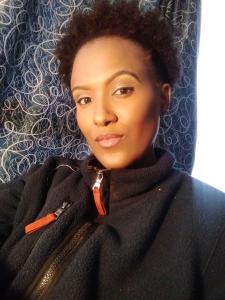
Carol Majola is a trained ECD educator, business management student, self proclaimed poet and author, and aspiring entrepreneur. She is passionate about community building and helping youth tackle social ills affecting them. Majola is advocate for issues such as bullying, GBV, and substance abuse. She believes that her purpose is healing and that words written or spoken are powerful to break but also heal and she found healing in poetry. To Carol, the two most powerful things are Love and words.
When did you start writing poetry?
I fell in love with poetry when we were learning about the history of our country when we were in school, when whites and blacks were separated during the apartheid era. And I fell in love with how expressive the writers of the “struggle” were and how they used the art to cope with their pain and loss, to communicate their feelings more eloquently. But it was when I lost my father at the age of nine, that I wrote my first poem.
What are your favorite words?
I am a lover so my favourite word is “love”.
My name “Carol” because it means “a joyful song”. I feel it explains why I love music so much.
Do you have a particular style of poetry you write? Have you ever experimented with form poetry? What were the results?
I do not think I have a particular style of writing my poetry, although most of my poems are in a similar structure. They are more expressive than rhythmic though.
I love words and playing around with words and therefore experimenting with form poetry was inevitable. My first exposure to poetry was form and studying poetry. With my work, I feel that form gave it more structure and allowed me to experiment with my rhyme scheme. Although the consideration of my lines and stanzas made it seem limiting in how I could express in depth, it did teach me careful consideration of my word choice.
April is Global Poetry Writing Month. Who are some of your favorite poets from around the world?
One of my memorable olden day favourite poet together with the likes of Charles Causley, would be a South African Poet by the name of “KEORAPETSE WILLIAM KGOSITSILE” who was not only a poet but a social and political activist who lived in Exile in the US in 1962. I love how he encouraged interest in Africa, African poetry and the practice of poetry as a performance art. Origins and Santamaria are some of my favorite works by him.
Maya Angelou has always been my favorite, as well as Rudy Francisco. I have my recent favourites who I have experienced through social media – Yaw Osafo (KINGYAW FROM GHANA) residing in the states and Hafsat Abdullahi (HAVFY FROM NIGERIA)…such powerful young poets.
AConjugal Suicide
Floating, barely breathing beneath the waters, In a bottomless ocean. Drowning, for I sold myself at the price of trust I recklessly handed over. Sun rays cast between my fears, Water covering my stream of tears, My wails muffled in the deep, Not even those shoring at sea Can see me, nor my weeps hear. I am dazed swimming in agony, In a sea a path to which I built With brick and mortar with which I tried to build my home That now lies desolate and forgone.
Eryn lives in South Germany with their family but is originally from Oxford, UK. They work freelance as a translator and a teacher. When not writing, they’re out on their bike in the forest or dreaming up new ideas to write about. They are obsessed with vinyl, fountain pen ink, dragons and cheese. Preferably not all together. Their current favourite thing is spring blossoms against the white clouds. They are working on two new poetry collections which will be released this year, Masquerade Me and Death by Sugar, and two fiction works, a Dystopian Scifi novella called The Dust Collector and a Gothic Horror called The Black Cat Bookshop.
As a huge fan of your book, which features illuminating poetry on PTSD, I feel like I have to address that. How did you overcome your initial fears and write about a topic that is still so taboo in so many places?
I didn’t want to write something hard, or dark, and I really didn’t want to write a poetry collection that is largely autobiographical. But I found that on occasion when I shared an individual poem, that people really resonated with it. I saw that there’s a lot of poetry about anxiety and depression, but hardly anything for PTSD. And ultimately, sometimes, it is on you to begin it. It was on me to say, this is what PTSD looks like. So it became a collection. It was, and I think will remain, the most difficult collection for me to complete and publish. But I don’t regret it.
Do you sit down with a poetry idea in mind or does it slowly develop as you sit in front of the page or monitor? In other words, what is your process?
I should probably mention that I am an aphant, which means that I have no visual landscape. I cannot conjure a memory and play it back as if it is in glorious technicolour. If someone asks me to imagine a box, I cannot see the colour or texture. I see a nondescript box. So when it comes to poetry, you could say that I am a blind poet.
My visual landscape is layered with music notes and quantum physics. I hear a concept of a poem, a shiver of something, and I have to follow it through to the end. It happens a lot with a phrase, an overhead conversation, perhaps, and then I have to chase the thread to the end. I do not always know where it will turn up.
It’s cliché, but each person’s answer is uniquely their own: what is the best writing advice you have received?
Don’t lose your own poetic voice.
What are three words you would use to describe your poetry?
Lyrical Layered Whimsical
Why do you write poetry?
I have been writing poetry since I was 16, and really, have never stopped. I never intended to make something from it, I never intended to call myself a poet. I studied both poetry and playwriting at University but poetry was the one that survived the grind of assignments, of life getting in the way, and it kept coming back. I write poetry because I need to write it. It is cathartic, somehow.
Is there a common motif in your writing that you find yourself returning to?
There are a few, yes.
In Of Swans and Stars I explored the ideas of my own North Star, that place that calls you home, the direction on the compass that we follow. So swans and stars, are very important to me, and you see amber, being cast in amber, featuring often. I write a lot about Druidry, mythology and folklore. Dragons will always be in my poetry. But at the heart of it all, is always love. Love for who we are, for where we have been, and where we are going.
If you could attend a poetry writing conference taught by any author, lyricist, poet, etc., living or dead, which two to three people would you choose and why?
Larkin. I love him, I love how he writes, his raw energy. Peter Gabriel. His wordsmithery is without equal. WH Auden. I want to hear him read and see how it is reflected in his eyes. I want to see how he writes.
A thousand cranes Paper art flying For peace in the world A thousand cranes Countless painstaking Paper folds For peace in the heart A thousand cranes Flying their dance On white string For peace in the eyes A thousand cranes Quiet time Each repetition A healing caress For peace in the soul A thousand cranes Origami sorcery Peace in the world Starts with ourselves.





 Isabelle Palerma