I remember tasting the tobacco shored in your lungs, and you had the courage to tell me my auburn hair smelled of a bonfire.
I once vowed a dress I owned would forever smell of rain and my ink-stained fingertips would fidget – restless with memories, but now, when I cradle myself to sleep, my eyes are empty.
I no longer name the silhouettes that landscape my bare walls or dance along my broken skeleton bones.
I remember when my brittle skin was scented like my favorite library, but no one picks up an abandoned tome when the ink that travels the pages is nothing more than a smudge and ashy dots.
I am an empty teacup in a house that is haunted with your name. When I reread the letters you wrote me, shards of glass glitter along voids of thought, threatening to lacerate the emptiness. To puncture the silence where memories once towered like infernos.
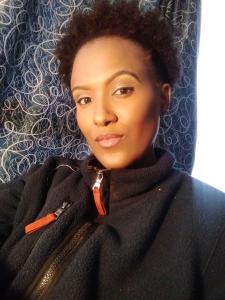
Carol Majola is a trained ECD educator, business management student, self proclaimed poet and author, and aspiring entrepreneur. She is passionate about community building and helping youth tackle social ills affecting them. Majola is advocate for issues such as bullying, GBV, and substance abuse. She believes that her purpose is healing and that words written or spoken are powerful to break but also heal and she found healing in poetry. To Carol, the two most powerful things are Love and words.
When did you start writing poetry?
I fell in love with poetry when we were learning about the history of our country when we were in school, when whites and blacks were separated during the apartheid era. And I fell in love with how expressive the writers of the “struggle” were and how they used the art to cope with their pain and loss, to communicate their feelings more eloquently. But it was when I lost my father at the age of nine, that I wrote my first poem.
What are your favorite words?
I am a lover so my favourite word is “love”.
My name “Carol” because it means “a joyful song”. I feel it explains why I love music so much.
Do you have a particular style of poetry you write? Have you ever experimented with form poetry? What were the results?
I do not think I have a particular style of writing my poetry, although most of my poems are in a similar structure. They are more expressive than rhythmic though.
I love words and playing around with words and therefore experimenting with form poetry was inevitable. My first exposure to poetry was form and studying poetry. With my work, I feel that form gave it more structure and allowed me to experiment with my rhyme scheme. Although the consideration of my lines and stanzas made it seem limiting in how I could express in depth, it did teach me careful consideration of my word choice.
April is Global Poetry Writing Month. Who are some of your favorite poets from around the world?
One of my memorable olden day favourite poet together with the likes of Charles Causley, would be a South African Poet by the name of “KEORAPETSE WILLIAM KGOSITSILE” who was not only a poet but a social and political activist who lived in Exile in the US in 1962. I love how he encouraged interest in Africa, African poetry and the practice of poetry as a performance art. Origins and Santamaria are some of my favorite works by him.
Maya Angelou has always been my favorite, as well as Rudy Francisco. I have my recent favourites who I have experienced through social media – Yaw Osafo (KINGYAW FROM GHANA) residing in the states and Hafsat Abdullahi (HAVFY FROM NIGERIA)…such powerful young poets.
AConjugal Suicide
Floating, barely breathing beneath the waters, In a bottomless ocean. Drowning, for I sold myself at the price of trust I recklessly handed over. Sun rays cast between my fears, Water covering my stream of tears, My wails muffled in the deep, Not even those shoring at sea Can see me, nor my weeps hear. I am dazed swimming in agony, In a sea a path to which I built With brick and mortar with which I tried to build my home That now lies desolate and forgone.
Eryn lives in South Germany with their family but is originally from Oxford, UK. They work freelance as a translator and a teacher. When not writing, they’re out on their bike in the forest or dreaming up new ideas to write about. They are obsessed with vinyl, fountain pen ink, dragons and cheese. Preferably not all together. Their current favourite thing is spring blossoms against the white clouds. They are working on two new poetry collections which will be released this year, Masquerade Me and Death by Sugar, and two fiction works, a Dystopian Scifi novella called The Dust Collector and a Gothic Horror called The Black Cat Bookshop.
As a huge fan of your book, which features illuminating poetry on PTSD, I feel like I have to address that. How did you overcome your initial fears and write about a topic that is still so taboo in so many places?
I didn’t want to write something hard, or dark, and I really didn’t want to write a poetry collection that is largely autobiographical. But I found that on occasion when I shared an individual poem, that people really resonated with it. I saw that there’s a lot of poetry about anxiety and depression, but hardly anything for PTSD. And ultimately, sometimes, it is on you to begin it. It was on me to say, this is what PTSD looks like. So it became a collection. It was, and I think will remain, the most difficult collection for me to complete and publish. But I don’t regret it.
Do you sit down with a poetry idea in mind or does it slowly develop as you sit in front of the page or monitor? In other words, what is your process?
I should probably mention that I am an aphant, which means that I have no visual landscape. I cannot conjure a memory and play it back as if it is in glorious technicolour. If someone asks me to imagine a box, I cannot see the colour or texture. I see a nondescript box. So when it comes to poetry, you could say that I am a blind poet.
My visual landscape is layered with music notes and quantum physics. I hear a concept of a poem, a shiver of something, and I have to follow it through to the end. It happens a lot with a phrase, an overhead conversation, perhaps, and then I have to chase the thread to the end. I do not always know where it will turn up.
It’s cliché, but each person’s answer is uniquely their own: what is the best writing advice you have received?
Don’t lose your own poetic voice.
What are three words you would use to describe your poetry?
Lyrical Layered Whimsical
Why do you write poetry?
I have been writing poetry since I was 16, and really, have never stopped. I never intended to make something from it, I never intended to call myself a poet. I studied both poetry and playwriting at University but poetry was the one that survived the grind of assignments, of life getting in the way, and it kept coming back. I write poetry because I need to write it. It is cathartic, somehow.
Is there a common motif in your writing that you find yourself returning to?
There are a few, yes.
In Of Swans and Stars I explored the ideas of my own North Star, that place that calls you home, the direction on the compass that we follow. So swans and stars, are very important to me, and you see amber, being cast in amber, featuring often. I write a lot about Druidry, mythology and folklore. Dragons will always be in my poetry. But at the heart of it all, is always love. Love for who we are, for where we have been, and where we are going.
If you could attend a poetry writing conference taught by any author, lyricist, poet, etc., living or dead, which two to three people would you choose and why?
Larkin. I love him, I love how he writes, his raw energy. Peter Gabriel. His wordsmithery is without equal. WH Auden. I want to hear him read and see how it is reflected in his eyes. I want to see how he writes.
A thousand cranes Paper art flying For peace in the world A thousand cranes Countless painstaking Paper folds For peace in the heart A thousand cranes Flying their dance On white string For peace in the eyes A thousand cranes Quiet time Each repetition A healing caress For peace in the soul A thousand cranes Origami sorcery Peace in the world Starts with ourselves.
This weekend, I’m interviewing author and poet ML Stevens. She is extremely talented and kind. When I told her it was my birthday, she gave me an autographed copy of her poetry book “Caged Heart”.
When she’s not writing, or listening to the characters that live in her head rent free, ML Stevens can be caught with her nose in a book or running when the weather permits it. She wrote her first “novel” at a young age after looking out her window one summer day and deciding it would be cool to write a book. Since then she hasn’t been able to put the pen down. She has many more projects planned, including (hopefully) more poetry to come.
Why do you like writing poetry, and how is it different from writing fiction?
It’s where I go to when I need to get something out then and there without writing a novel. Often times, it’s where I go when I’m upset about something that has been weighing on me. Secondly, it flows easily. It’s never hard for me to know what to write into a poem.
Poetry for me is easier than writing fiction. I can whip out a poem anytime and anywhere while with fiction, I can come up with an idea like that, but it takes a lot more time and work to get it written on paper.
Where is your ideal writing space?
I have always felt weird about this question because I don’t have one ideal writing space. I enjoy writing in a coffee shop or at my desk just as much as I enjoy writing on my couch or even outside.
If you ever were to hold a poetry reading, where would you hold one?
I never have held a poetry reading but would love to do one in a cozy library like the library rat I am.
What is your biggest inspiration?
I think for poetry my biggest inspiration is life. the ups and downs of it as well as the people who are part of it. Life itself is artwork, much like poetry, and and there’s so much that I draw from it when I’m writing a poem.
Specific scenarios of hate, anger, sadness, happiness, love, friendship – even nature and all it has to offer can be found in my poetry.
What’s your favorite thing about writing poetry? Your least favorite?
My favorite thing is how quick it is for me. It’s something I can turn to when I’m in a meeting and struggling to stay awake. It looks like I’m taking notes. It’s also there when I want to write something but I am not sure if I want to start a novel or a short story.
If I had to pick a least favorite part about writing poetry, for me personally, it would be how damn personal it comes out ninety percent of the time. It’s a little more difficult for me to write a poem that isn’t personal in at least some way.
When did you begin writing? How has your poetry evolved since then?
In general, I have been writing since I was eight. I didn’t writing poetry until I was twelve or thirteen. In fact, I had never even read a lot of poetry until my middle school Creative Writing teacher made an assignment for us to write thirty different types of poems. I enjoyed writing poetry after that.
My poetry then was simplistic and not as deeply personal as it is now. As I continued to write poetry, it became more complex for me and much more personal. Many of my poems are based on my own experiences and emotions.
What’s your favorite word? Least favorite?
I can’t say I have a favorite word, but I am fond of the words scintillating and surreptitiously. I really don’t know why. For my least favorite words, I have a few that make me cringe. Gyrating is one of them.
Something long gone That can’t be recovered A broken world Filled with greed A shattered soul The pieces scattered A dreadful tempest Roars inside A tender heart That barely beats A soft voice whispers,
Sakshi Narula is a poet, author and an artist from India who lives in Muscat, Oman. She is the author of four poetry collections and also a spoken word artist. Her words center around love, loss, healing, grief and femininity. Some of her poems have been featured in the Survival Anthology by Magesoul Publishing, From One Line Anthology, Book One by Kobayaashi Studios and in Yellow by Yellow Penguin NYC.
I have been reading Sakshi’s poetry for a couple of years now, and she is incredibly gifted. Her poetry is the kind you can find yourself immersed in for hours and not even notice the passing of time. It surpasses the standard of contemporary poetry and should be recognized for its unique and profound style.
Sakshi, your poetry book is unlike any I’ve seen before, and your poems are so refreshingly different from a lot of what we see on social media. Where do you get your inspiration? Have you ever been compared to any other poets? If so, who? If not, who are some of your favorite poets and why?
I have been through a lot of ups and downs like any other person. My writing is a reflection of the things that happened in my life in some form or another. Music and books have always been my steady companions and have inspired a lot of my work too. Yes, I have been compared to a lot of poets in certain reviews purely because I write love poetry and poetry that centers around loss and heartbreak. It would be really boastful of me to state their names so I am going to refrain from doing that, but it has been rather overwhelming and flattering. To answer your last question, my favorite poets are Ada Limon, Andrea Gibson, Sharon Olds, Pablo Neruda, Wendy Cope, Leonard Cohen, to name a few.
When did you begin writing poetry and what was the process like?
I started writing poetry seriously around five years ago. I used to be a blogger and used to ghost write articles before that. It was really surprising to me how organic the process of poetry writing was for me. It was like being in a second skin, like I was meant to do this. I always say poetry found me and helped me heal when I needed it the most. It almost always would start with a line and I would spend hours building and rebuilding a poem obsessively. There are days I would be surprised at how I even ended up writing something that I actually liked reading. In that sense, it has helped me realise that this is a gift, that it has the power to comfort another and I need to use that gift in the best possible way.
How important is revising to you and your writing? Which pieces end up needing the most revisions? Why?
It is extremely important. I think to add layers to your poems, you need to be meticulous with editing and revising. That is what separates a good poet from a great poet. For me, it is going through every line and every word to make sure it is essential to the poem as a whole. Most pieces that are long form and usually poems that I use for spoken word require the most revisions. There needs to be a flow, a rhythm, the ebbs and the flows, the crescendo in the end, a punch in the gut, a feeling that remains with the reader, that takes the most effort.
What subjects are absolutely off-limits to write about?
I don’t write about mental health. I did try, but it takes a lot out of me to write about my struggle with depression and anxiety. I don’t write about certain aspects of my life because it brings a lot of things to surface.
What is your favorite poem? (Of another poet’s? Of your own?)
My favorite poem by me is 41 , A Love Poem To Me. Of another poet… True Love by Sharon Olds, Maybe I Need You by Andrea Gibson
You ask fascinating questions on social media – ones that challenge your readers and fellow authors/poets to think outside of the box. How important do you think it is to think outside of the box as a poet? Do you ever use your fans’ answers as a jumping off point for a poem? If so, what question was it that inspired the poem?
Never really used any answers from Twitter for a poem, but they definitely make for great conversations. It has been fun interacting with writers and readers from all walks of life and countries. It’s beautiful how art and writing connects us all on a very basic human level. More than thinking outside the box, I feel a poet needs to own their voice. Writing to fit a mould on social media or to be able to sell more books can rob one of their authenticity.
Do you have any writing rituals? What arethey?
Not really. I haven’t been writing much after I wrote House Of Stars And Flowers On Mars. Maybe it is just a phase. I write when the words find me. I do keep making notes during day if a beautiful line or idea for a poem comes up in my head. When I am writing I do keep going through those ideas.
I know some poets require complete silence when they write, others want ambient noise, and there are some who write to music. What kinds of sounds do you find it easiest to write to? Or none at all?
I enjoy writing with music in the background. I just can’t write with people talking continuously around me. I have my own writing playlists and I play them and write.
What is something you’re afraid of?
I am afraid of losing the people I love and I think that is pretty universal. As a writer I am afraid of not ever having one shining moment with my poetry. But that is what keeps me working on my craft. I just think the only way I won’t accomplish anything is by giving up and I am pretty strong-willed not to give poetry or my ambitions up.
Why do you write poetry?
I started writing because I was in pain and poetry was my safe place, a way to turn that pain into art, a creative release. Now I write because I want to be understood, to be heard and I want to make sense of this world we live in. I always believe there is a poet for everyone, there is a poem in the world that can understand and comfort you, no matter what you may be going through. Poetry is for everyone. So I write because someone may find their comfort in my words and feel seen and not feel stupid for feeling something. Even if there is one person who doesn’t feel alone after reading a poem of mine or my book, then I think it’s important for me to continue writing.
41, I tear open a song like it’s a gift, a birthday present from Lana, Morrison or Lennon I dig their hearts out from the graves in their words, soothe the scars, 41 scars on mine and sing it out loud, with a mouthful of wine Blink once and I was 10 and blink twice and I’m 41 41, I think, maybe ten years or 14 more to go, I bought a boxful of watercolors and I haven’t learned how to make watercolor paintings yet. I have a book about kitchen gardening and don’t know what needs to be planted yet. Blessed kitchen garden. Blessed kitchen, blessed garden, blessed home. Yes, I have been blessed with love, knock the wind out of me love, my body hurts, soaked to the bone love. Blessed with a lover, the man of my dreams and angel baby souls, 2 playing in the backyard and 2 in heaven at the end of the rainbow. They grow, they smile, they laugh, they glow and they keep me alive, away from the darkness and never let me go. But my nightmares are made of the mountain of dishes in the kitchen’s unholy sink, no friends to cherish, no friends to ring. I turn a blind eye like they don’t exist and think about strawberries and tomatillos, and rosemary and habaneros, the bath salts and the collagen I need, about the dark chocolate cake, the beautiful shoulder of lamb in the fridge, and the crimson sunset today at 41 at my feet. Yes, I have nowhere to go, nowhere to be I mute everything, the phone, the world, the unkempt hair and organic white sheets. For I will not be as young as I am today, as pretty as I am today, as unashamed and unapologetic than I have ever been. I built a home of poems and a kiln of all the stars in my heart, a home in the middle of wheat fields 41 bricks on the fireplace for 41 poets who kept me warm on the nights I weeped. What would Bukowski say about my poems I wonder? Am I a comfortable poet or someone from the street? I write my story like it’s everyone’s story, and everyone’s in it, sonder! 41, Sonder is my favorite word from The Dictionary of Obscure Sorrows, from any dictionary ever. 41, I reflect on the triumphs of all my yesterdays and the ones to happen tomorrow. Let me be your woman on love’s landscape, the slow burn of a song on a cold night, the blurring bokeh of city lights. Let me fix your ribs like I fixed mine, life broke us all differently but broke it did And so, I poet at 41, I send you a verse dipped in the smell of rain on a hot summer day, dipped in love from my brave undying heart, and light from a thousand burning dreams in my eyes. 41, smug, the coffee and I are so hot I laugh I resist, I fight, I switch on the table lamp and write.







 Isabelle Palerma